

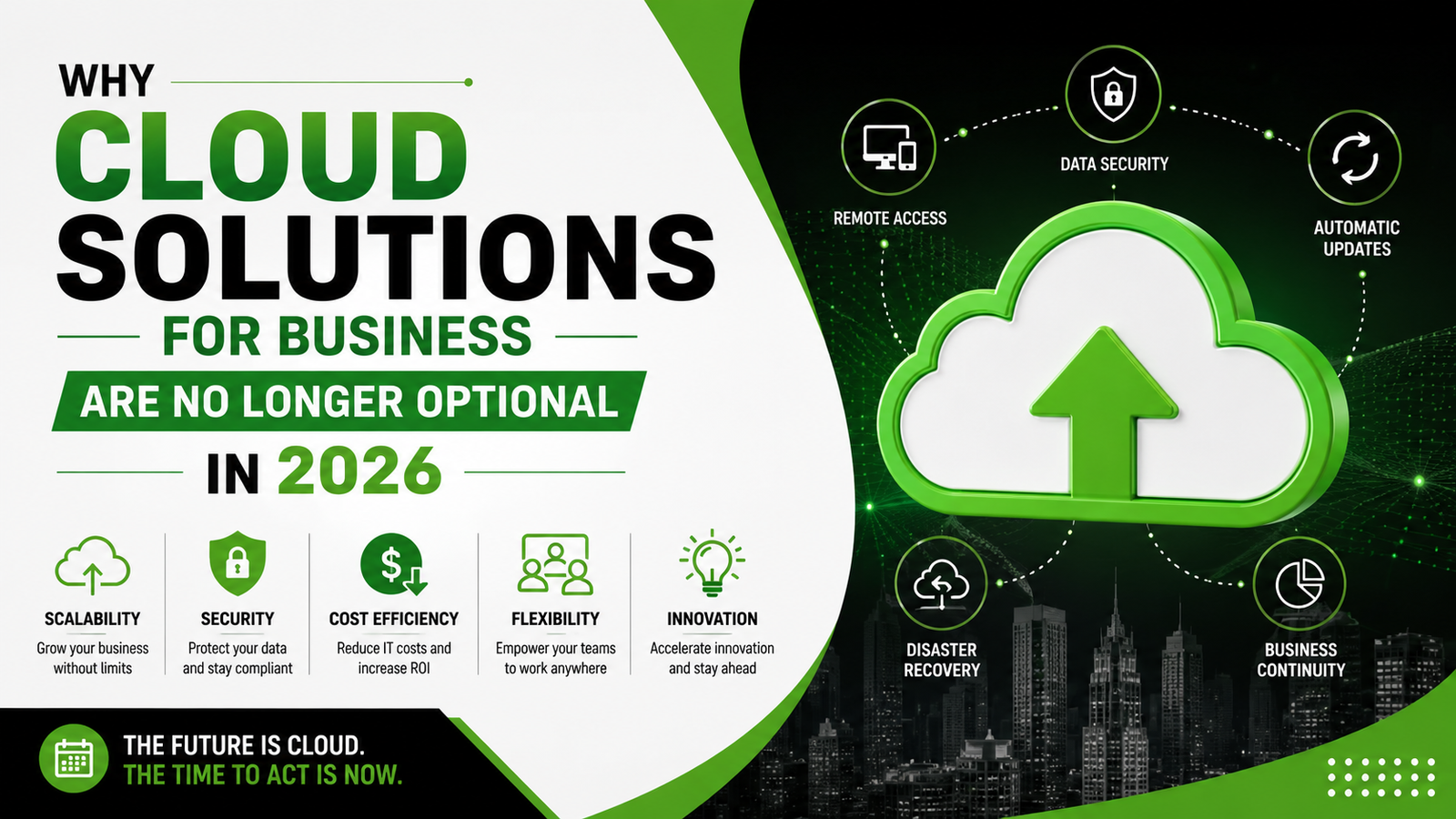
Any business running on all servers in 2026 is losing money, time and edge in competition. Business cloud solutions are the new wave of change every business needs to ride on to stay ahead of its competitors in this day and time.
Cloud solutions for business have changed how companies operate, grow, and protect their data. From startups to large enterprises, the shift to the cloud is now a core business decision. And the numbers back this up strongly.
According to research, the global spending on Business cloud solutions jumped from $595.7 billion in 2024 to $723.4 billion in 2025. That is a 21.5% increase in just one year.
Clearly, businesses around the world are voting with their budgets.
What Are Cloud Solutions for Business
Simply put, cloud solutions for business mean you run your software, store your data, and manage your operations over the internet. You do not need physical servers sitting in a back room. Instead, you access everything through a secure online connection.
There are three main types you should know. First, there is Infrastructure as a Service or IaaS. Second, there is Platform as a Service or PaaS. Third, there is Software as a Service or SaaS. Each one serves a different business need. Many companies use a mix of all three today.
Importantly, top cloud hosting companies like Amazon Web Services, Microsoft Azure, and Google Cloud power most of this industry. Only AWS holds a 31 to 32 percent market share as of 2024. Then comes Azure with around 20 to 23 percent of the market share. Together, these three providers control over 66 percent of the global public cloud market.
How Cloud Infrastructure for Small Businesses Changes the Game
Many small business owners think cloud technology is only for big companies. That belief is costing them real money. Today, a 20-person team can run on the same powerful infrastructure as a 20,000-person organization. That was simply not possible before.
In fact, small businesses are among the fastest adopters of cloud services right now. According to recent data, 61 percent of small business workloads already live in the public cloud. That number keeps climbing each quarter.
Furthermore, the cost savings are significant. Buying physical servers, storage units, and networking gear can cost a small business anywhere from $15,000 to $100,000 before a single employee logs in. Cloud infrastructure removes that burden completely. You pay only for what you use.
According to a 2025 IDC report, mid-sized businesses save 30 to 50 percent annually by moving server maintenance and software patching to a cloud provider.
Additionally, AWS Compute Savings Plans can cut costs by up to 72 percent for committed usage. These are not small wins. These are budget-changing results.
Top Benefits of Scalable Cloud Services
Scalability is one of the biggest reasons businesses move to the cloud. Traditional systems force you to buy new hardware every time you outgrow your current setup. On the other hand, Cloud platforms let you scale up or down in minutes based on actual demand.
Here are the key benefits of business cloud solutions worth knowing:
1. Cost Efficiency
Usually, the traditional IT requires a large upfront investment. Conversely, cloud solutions for business use a subscription or pay-as-you-go model. Moreover, auto-shutdown schedules alone can save up to 60 percent on energy and runtime during off-peak hours. Not to mention, tools like AWS Cost Explorer help you identify wasted spending and reclaim up to 25 percent of your budget.
2. Business Continuity and Disaster Recovery
FEMA data shows that 40 percent of small businesses never reopen after a disaster. Another 25 percent close within a year. Cloud-based backup and recovery directly reduces this risk. Aberdeen research found that cloud-based businesses resolve disaster recovery issues in just 2.1 hours. Non-cloud businesses take more than 8 hours for the same task.
3. Remote Work and Team Collaboration
When files, applications, and tools live in the cloud, your team works from anywhere. The pandemic proved that remote work is real and permanent. Cloud infrastructure makes this possible without technical headaches.
4. Automatic Updates and Maintenance
Cloud providers handle updates, patches, hardware monitoring, and replacements. Meanwhile, your team focuses on actual business tasks instead of the constant IT firefighting. The change surely leads to fewer disruptions and more productive hours each week.
5. Environmental Benefits
Moving to Infrastructure as a Service can reduce your carbon emissions by up to 84 percent and cut energy consumption by up to 64 percent. Accenture confirmed these figures in a detailed comparison of cloud versus on-premises operations.
How Cloud Solutions Help Businesses Scale Faster
Uniquely, scaling up with cloud infrastructure is straightforward. You do not need to order hardware, wait for delivery, or hire a technician. You log into your cloud dashboard and increase your resources in minutes.
This speed matters a lot in competitive markets. For instance, if your e-commerce site gets sudden traffic during a sale or ad campaign, the cloud platform is ready to handle the surge automatically.
If business slows down, you scale back and stop paying for unused capacity. Furthermore, serverless cloud services like AWS Lambda charge only per invocation.
Ideally, the model dramatically reduces costs compared to always-on virtual machines. For growing businesses, this means you only pay when your service is actually running.
Choosing the Right Business Cloud Solutions Provider
Picking the right provider depends on your specific business needs. Here are three questions to ask before you decide.
First, what kind of workloads do you need to run? Heavy computing tasks suit AWS or Google Cloud. Microsoft-heavy environments benefit most from Azure.
Second, what is your budget? Most providers offer free tiers and pay-as-you-go pricing. Compare them honestly against your current IT spending.
Third, do you need managed support? If the team at your office doesn’t have the cloud expertise, a managed service provider handles migration, monitoring, and optimization for you.
You can explore more about tailored business cloud solutions at https://14kbsol.com/.
Frequently Asked Questions
How do cloud solutions help businesses scale faster?
The need to upgrade hardware every five years is gone. With the cloud dashboard, it takes minutes to scale. You pay only for what you use, so there is no wasted spending. Auto-scaling tools handle sudden traffic spikes automatically. This means your systems stay online and responsive even during peak demand. Businesses using scalable cloud services can enter new markets faster because they do not wait for infrastructure.
What are the benefits of scalable cloud services?
Well, the scalable cloud services give you flexibility, cost savings, and operational speed. You start small and grow without limits. You do not invest in servers that may sit idle half the time. Instead, your resources match your actual needs at all times. Cost savings of 30 to 72 percent are documented and real. Additionally, you get built-in disaster recovery, automatic updates, and access to enterprise-grade security tools.
Why are cloud solutions important for modern businesses?
Modern businesses run on data, speed, and flexibility. Cloud solutions provide all three. Over 94 percent of enterprise organizations already use cloud computing. The ones that hold back face higher IT costs, slower operations, and greater security risks. Cloud infrastructure also supports AI tools, analytics platforms, and automation systems that give businesses a competitive edge. In short, cloud solutions are not just an IT upgrade. They are a business strategy.
Conclusion
Cloud solutions for business have moved past the early adoption phase. They are now the standard way to run a competitive operation. The data is clear, the savings are real, and the risks of staying on old infrastructure keep growing every year.
Whether you run a five-person startup or a growing enterprise, business cloud solutions give you the tools to move faster, spend smarter, and protect your data better. Cloud data security has also matured significantly, and top providers now offer compliance-ready environments that most in-house teams cannot match.
The shift is not just technical. It is strategic. Businesses that invest in the right cloud infrastructure today position themselves to grow without limits tomorrow.
With 14K Business Solutions, you can ride the wave, become the tide, and help your business soar to new heights. Book a free consultation today and explore how the change can help your business grow.