
If you are still letting automation call the shots on your SEO strategy, Google’s latest updates have a message specifically for you, and it is not flattering.
Every major algorithm update since mid-2024 has pointed in the same direction: real expertise, genuine experience, and people-first content win. Thin, auto-generated, or tool-optimized content keeps losing ground.
The December 2025 Core Update alone caused 40–60% of websites globally to see measurable ranking changes, with sites publishing mass-produced AI SEO tools output taking the hardest hits.
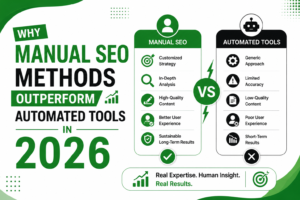
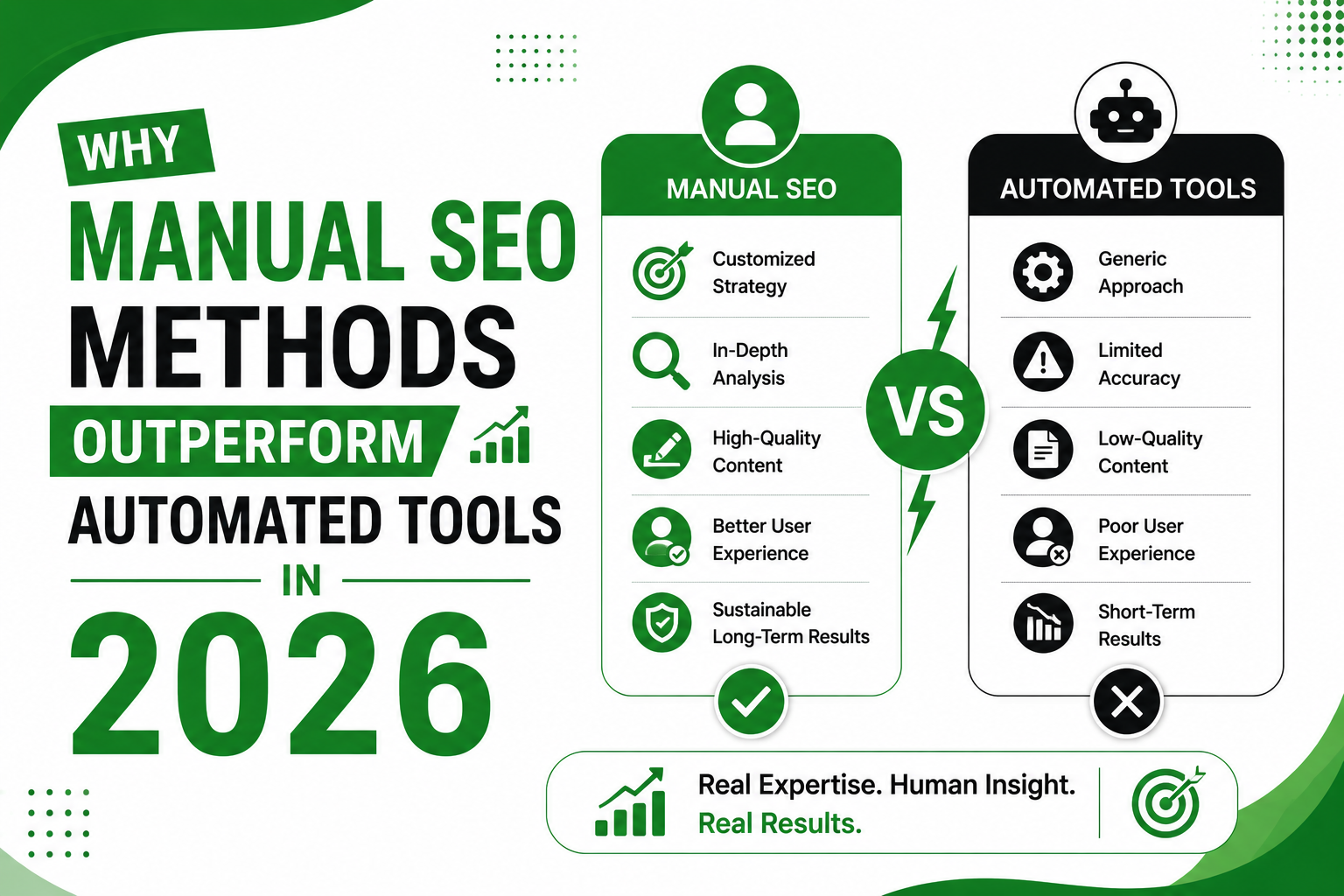
Manual SEO is not a nostalgic throwback. In 2026, it is the smarter play, and the data backs that up.
What Automation Gets Right
Let’s be fair. SEO automation tools do certain things well. Rank tracking, site crawls, broken link detection, and bulk meta-audits. Although these are tedious, repetitive tasks, tools handle them efficiently. Nobody should do those things manually.
But here is where most businesses get it wrong. They stop at the tool. They feed keyword suggestions directly into content briefs, publish AI-drafted pages at scale, and call it an SEO strategy. That is not a strategy; that is a liability in 2026.
Google’s Helpful Content system now forms part of its core ranking algorithm, evaluating whether content was built for users or for search engines. The distinction matters more than it ever has before.
Why Manual SEO Wins in 2026
Google Rewards What Automation Cannot Fake
The March 2026 Core Update placed a heavier weight on firsthand experience, verified expertise, and original analysis, the exact signals AI SEO tools cannot generate on their own. A crawler cannot have an opinion. A tool cannot draw from a decade of industry experience. It cannot write something a reader has never seen before.
Manual work produces exactly those things. When an expert writes from real experience, cites credible sources, and structures content around what users genuinely need, Google’s systems are increasingly sophisticated at recognizing that quality and rewarding it.
Automation produces patterns. Google has become very good at spotting patterns.
E-E-A-T Cannot Be Automated
Google’s framework, Experience, Expertise, Authoritativeness, and Trustworthiness, is now applied well beyond health and finance content. The September 2025 update expanded E-E-A-T evaluation across all content categories, rewarding verified author profiles, real-world case studies, and firsthand perspectives.
You cannot automate a track record. You cannot automate trust. Both require a human being putting their name, knowledge, and reputation behind the work.
Link Building Still Needs a Human Touch
Organic search ranking in competitive niches depends heavily on backlink quality. And quality link building, finding the right prospects, crafting personalized outreach, and building actual relationships with editors and publishers is something no AI SEO tool does with any real effectiveness.
Tools can find domains. They cannot start a conversation. They cannot read the room on whether a pitch will land. That judgment still belongs to a person.
Where Automation Creates Real Risk
This is the part vendors will not tell you. Scaling content through automation feels efficient until an algorithm update hits. Then you discover that hundreds of pages optimized for keywords, but not built for users, are dragging your entire domain down.
Google confirmed that one unhelpful page can affect the rankings of an entire site if low-quality content is widespread enough. That is a compounding liability, not just a single-page problem.
We have watched businesses burn for months trying to recover from exactly this. They scaled fast, ranked briefly, then lost visibility when a core update recalibrated the quality standard.
The recovery process, auditing hundreds of pages, rewriting thin content, rebuilding trust signals, costs far more time than a careful, manual approach would have from the start.
What Manual SEO Actually Looks Like in Practice
Manual SEO is not about doing everything slowly. It is about applying human judgment at the points where judgment actually matters.
Here is what that looks like across key areas:
| SEO Area | Automate | Keep Manual |
| Rank tracking | ✓ | — |
| Site crawl & technical audits | ✓ | — |
| Keyword research | Assist only | Intent analysis, topic framing |
| Content creation | Never | Always |
| Link building outreach | Templates only | Strategy, personalization |
| Technical SEO | Detect issues | Fix decisions |
| Internal linking strategy | — | ✓ |
| E-E-A-T signals | — | ✓ |
The tool finds the issue. The expert decides what it means and what to do about it.
Technical SEO Optimization: Automation Helps, Humans Decide
Technical SEO optimization is one area where the tool-versus-manual debate is most often oversimplified. Tools excel at identifying crawl errors, duplicate content, page speed issues, and schema gaps. That part is genuinely worth automating.
What tools cannot do is prioritize intelligently. Not every crawl error matters equally. Not every speed fix will move rankings.
An experienced SEO professional reads the full picture, site architecture, content strategy, and competitive context, and decides where technical fixes will actually drive results.
Search Engine Land’s 2026 evaluation guide put it well: connecting data from GA, GSC, and CRM systems to understand whether SEO work is converting to real revenue is still something that requires human interpretation.
That layer of judgment is what separates an SEO audit from an SEO strategy.
Manual SEO and Long-Term Ranking Stability
There is a pattern that holds across competitive niches. Sites that grew organically through consistent, expert-driven content and genuine link building tend to hold rankings through algorithm updates.
Sites that spiked through automation tend to lose ground when Google recalibrates.
Google’s own guidance is unambiguous: avoid quick-fix changes and focus on improvements that serve users over the long term. That is not a suggestion written with SEO automation tools in mind.
Long-term organic search ranking stability comes from building something worth ranking. That requires human expertise at the center of the strategy, using tools to work faster, not to replace the thinking.
Frequently Asked Questions
Why are manual SEO strategies still more effective than AI automation tools in 2026?
Because Google got a lot smarter. Every core update since 2024 has pushed harder on E-E-A-T: real experience, actual expertise, content that feels like a person wrote it for another person. AI SEO tools can optimize a page. They cannot replicate the perspective of someone who has genuinely worked in a field. That gap shows up in rankings, especially after algorithm updates hit and automated content takes the first fall.
Can automated SEO tools really replace expert-driven manual SEO techniques?
Honestly? Not even close. Tools are good at the grunt work: crawling, tracking, flagging issues. But the decisions that move rankings, what angle to take on a topic, which links are actually worth pursuing, whether a piece of content will satisfy what a user is really looking for, those still need a human. The December 2025 Core Update was a wake-up call for anyone who thought otherwise. Sites leaning on SEO automation tools for content at scale got hit hard, and many are still recovering.
What makes manual SEO deliver better long-term rankings than automation-based SEO?
It comes down to what Google actually trusts. Manual SEO builds the kind of signals that hold real authority on a topic, backlinks earned through genuine outreach, and content people actually read and reference. Automated approaches tend to optimize for what is working right now, which makes them fragile. The moment Google updates its quality standards, those rankings soften. Sustainable organic search ranking is a byproduct of doing work that earns it, not work that tries to game it.
Parting Thoughts
At 14 K Business Solutions, we build SEO strategies around expert-driven fundamentals, using tools where they help, and keeping human judgment where it counts.
If you want rankings that hold, not just spike, that is the only approach that works in 2026.