
Design System

barira

Our Blog

inspiring, insightful & accurate

Lorem ipsum dolor sit amet, consectetur adipiscing elit. Ut elit tellus, luctus nec ullamcorper mattis, pulvinar dapibus leo.

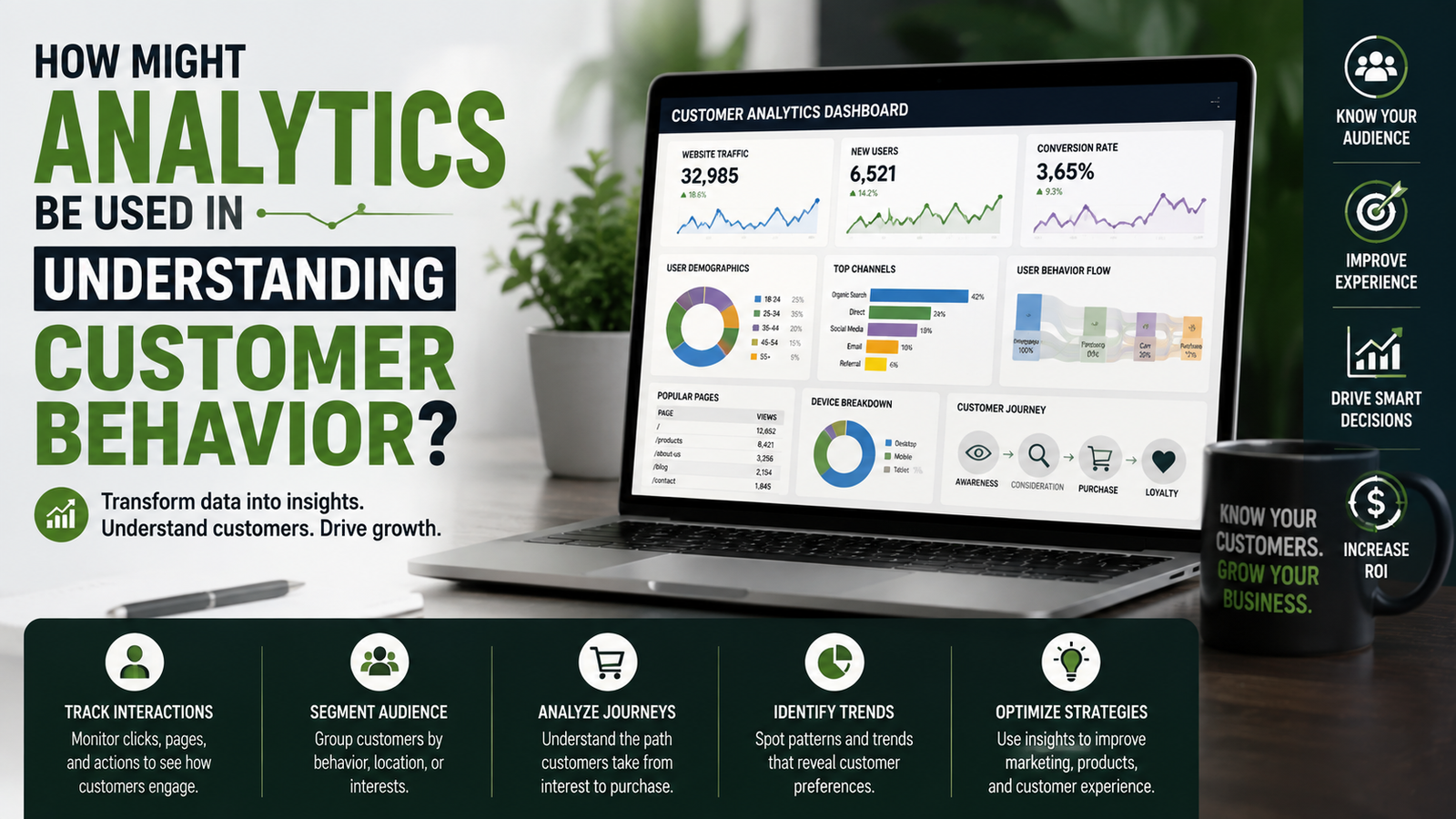
Customer analytics dashboard showing website traffic, user behavior, audience segmentation, customer journeys, trends, and conversion data.

How Might Analytics Be Used In Understanding Customer Behavior

Every click, every scroll, every abandoned cart is basically a customer telling you something, whether you are listening or not. Businesses that actually pay attention tend to grow faster than the ones running on gut feeling alone. Customer behavior analytics takes all that raw data and turns it into something usable. It gives a real picture of what people want, where they get stuck, and what finally gets them to hit buy. This piece walks through how businesses actually use Google Analytics to read their customers. What tools make it possible? Why does it end up shaping everything from ad budgets to product roadmaps? What Customer Behavior Analytics Actually Tracks At the core of it, customer analytics follows a customer across every point they touch a business. The tracking starts from the first ad they scroll past all the way to checkout, or the moment they just close the tab and leave. Website behavior gets watched closely here. You get a complete idea of which pages people linger on, where they bail, and how long they sit before giving up without buying anything? Purchase history fills in more of the picture too, showing which products tend to get bought together and who keeps coming back for more. Lately, platforms have started pulling in sentiment as well. You get mining reviews, support tickets, even social media comments to figure out how people actually feel, not just what they clicked. One page view alone tells you nothing. Thousands of them, stacked against purchase data, start telling a real story. Turning Data Into Actual Customer Insights Collecting the data is honestly the easy part. The hard part, and the valuable part, is turning it into real customer insights. Meaning, this data is something a business can actually act on instead of a dashboard nobody looks at twice. Segmentation earns its keep here. It works by grouping customers by behavior or spending habits so a business stops blasting the same offer at everyone and starts sending the right message to the right group. Predictive analytics pushes this further still. Say a retailer notices customers who buy running shoes tend to come back within three months for socks or apparel. That is not a coincidence worth ignoring, it is a signal worth building a campaign around. Consumer behavior analysis works the same way for spotting churn, catching the quiet signs that someone is drifting away before they actually disappear for good. Where This Data Actually Gets Used Marketing teams lean on behavior data constantly, and it shows in how advertising works today. Google ads read behavioral signals to put ads in front of people already circling something similar. Of course, these ads are blasting a broad, untargeted campaign and hoping something sticks. Local businesses get a version of this too. Google local service ads match nearby customers actively searching for a service with the businesses that offer it, based largely on intent and behavior. It goes beyond ads, though. Product teams use behavior data to figure out what to build next, chasing actual friction points instead of guessing what customers might want. Support teams benefit too. With this data, brands can know a customer’s history before the call even starts. As a result, you cut resolution time and make the whole interaction feel less like starting from zero. Solid digital marketing strategies now build analytics into the whole customer journey, not just the marketing department’s corner of it. Why This Matters More Now Than It Used To Competition is not slowing down in any industry. Also, businesses running purely on instinct keep losing ground to the ones backing decisions with real numbers. Understanding customer behavior means spending marketing dollars where they actually convert. You can benefit from it instead of spreading thin across tactics that sound smart but underperform once the numbers come in. That precision counts even more for smaller businesses working with tighter budgets than the big players. Customers expect to feel understood too, more than they used to. A business that misses that expectation starts losing people to competitors who clearly get their audience better. Analytics is what closes that gap, turning scattered clicks and purchases into an actual picture of what customers want at each stage. Frequently Asked Questions How can analytics improve customer experience? It shows you exactly where people get stuck, a confusing checkout, unclear product details, whatever it is. Fix what the data actually points to instead of guessing, and the experience gets smoother fast. What is customer behavior analytics? It is the practice of collecting and studying how customers interact with a business. Moreover, it measures website activity, purchase history, engagement across channels, all of it. That data helps businesses spot patterns and get ahead of what customers are likely to do next. How does data analytics help understand customer behavior? It catches patterns across huge volumes of interactions that nobody could spot by eye alone. Trends in browsing, buying, and engaging, all of it adds up to a clearer read on what actually drives customer decisions. Why is customer behavior analysis important? Because it keeps decisions grounded in reality instead of assumptions, across marketing, product, and support. Skip this step, and businesses end up pouring resources into things customers never actually wanted. Bringing Analytics Into Your Growth Strategy Understanding customer behavior is not really optional anymore for a business trying to compete. It is part of how smart decisions get made now, whether that is sharpening ad targeting or shaping what gets built next. 14 K Business Solutions helps businesses put this into practice, turning customer behavior data into growth that actually shows up in the numbers.
Read More »
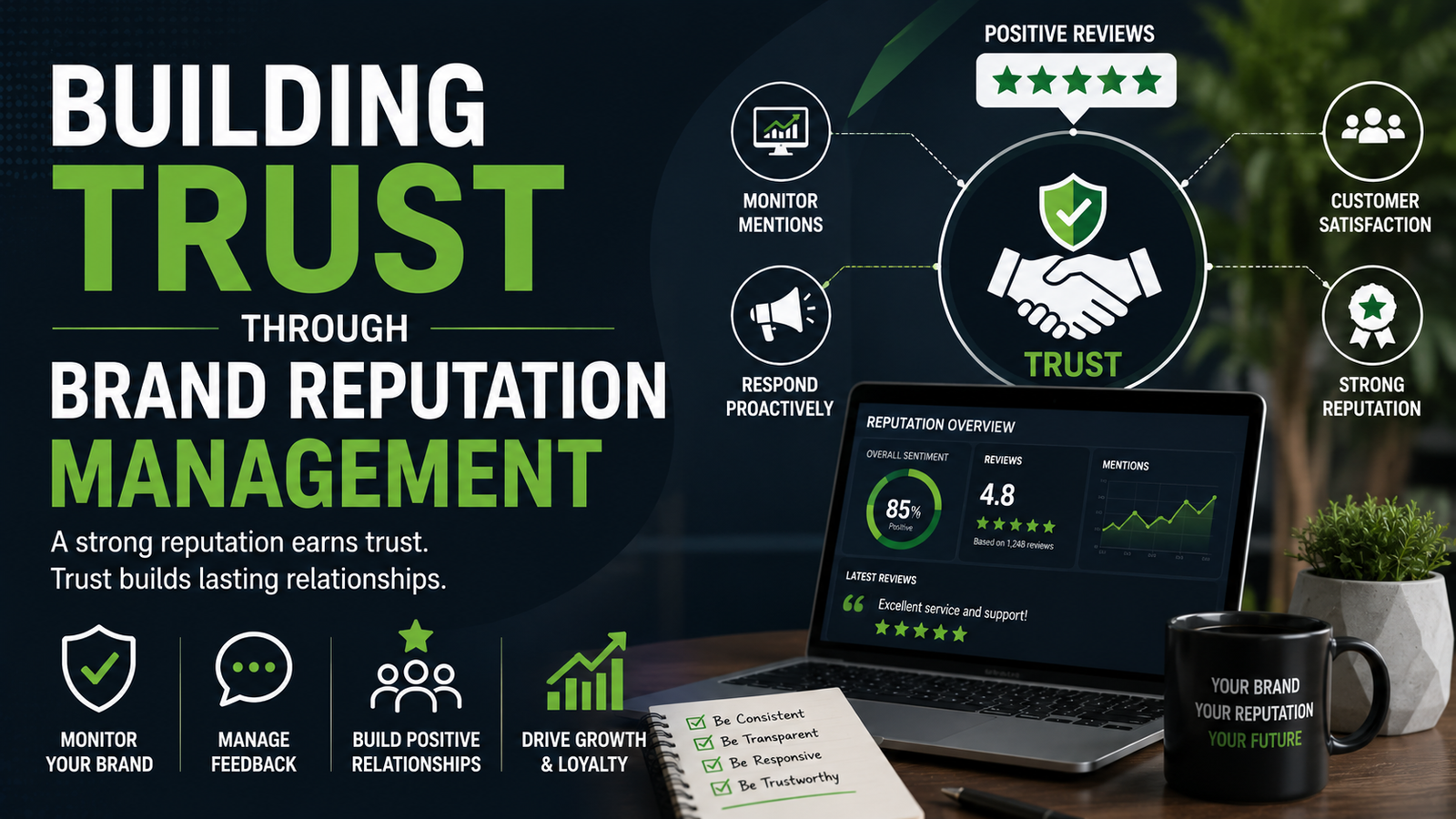
Brand reputation management graphic showing trust, positive reviews, customer satisfaction, feedback management, and reputation monitoring.

Building Trust Through Brand Reputation Management

A single bad review used to disappear into the noise. Now it sits at the top of a Google search for years, shaping what strangers think about a company before they ever place an order. That shift is exactly why brand and reputation management has become something businesses cannot afford to treat as an afterthought anymore. The piece breaks down what real reputation management actually looks like. Also, why it matters more than most owners realize. What Brand Reputation Management Actually Means At its core, brand reputation management is the practice of shaping and protecting how a business gets perceived, both online and off. It covers everything from responding to a one-star review to monitoring what people say on social media when nobody is watching. Ignore this work, and the narrative around your business gets written entirely by other people, sometimes fairly, sometimes not. Here is the part a lot of business owners miss. This is not just crisis control, showing up only when something goes wrong. Real business reputation management runs constantly in the background. Moreover, building goodwill during the quiet stretches so a company has something to fall back on when a tougher moment eventually shows up. Because eventually, it does. Why Online Brand Reputation Carries So Much Weight Now People research before they buy almost everything now. The habit has completely rewritten how businesses get judged. A company’s online brand reputation often gets shaped by things it never directly controls. The measurables like reviews, forum threads, random comments buried in a Reddit post from two years ago. Ignore that terrain, and someone else decides what shows up first when a potential customer searches your name. Social proof carries serious weight here too. Seeing consistent five-star reviews next to thoughtful, professional replies to the rare complaint tells a customer something real about how a business treats people. That contrast, a company that responds instead of hiding, builds brand trust faster than almost any advertisement ever could. Word spreads fast in the other direction too. One dismissive response to a legitimate complaint, and that screenshot can travel further than the business ever wanted it to. How Brand Reputation Shapes Customer Trust And Buying Decisions Trust is not some soft, feel-good concept sitting off to the side of business strategy, it is the thing that actually decides who gets the sale. When two competitors sit side by side, customers overwhelmingly lean toward the one with stronger reviews and a cleaner reputation. The connection between customer trust and brand reputation shows up clearly in the data, not just in gut feeling. This dynamic hits repeat business even harder than first-time sales. A customer burned once by poor service, or by a company that stayed silent during a public complaint, rarely comes back to give a second chance. Meanwhile, businesses that consistently show up change the narrative. When they admit mistakes and follow through on fixes tend to build a loyal base that sticks around.  Reputation Management Strategies That Actually Work Monitoring comes first, and it cannot be something you only think about after a bad review notification shows up. Set up alerts for brand mentions across review sites, social platforms, search results, all of it. Catching a problem early beats scrambling to fix it once it has already spread. A real reputation management strategy treats this like a daily habit, not something squeezed in whenever there is spare time. How fast you respond matters almost as much as what you actually say. Someone complaining publicly wants to see you address it within a day or two, calmly, without getting defensive about it. That alone tells people watching from the sidelines that this is a business that actually cares when something goes wrong. Getting happy customers to leave reviews helps balance things out too. A handful of negative reviews sitting by themselves reads very differently than those same reviews buried under dozens of good ones. And do not just show up on one platform and ignore the rest. A business that handles Google reviews well but goes silent on Facebook sends a mixed message, and people notice that inconsistency more than you would think. Treat every platform the same way, and there are fewer cracks for problems to slip through unnoticed. Frequently Asked Questions What is brand reputation management and why is it important? It is the ongoing work of shaping how people see a business, online and off. It matters because reputation drives buying decisions directly, and businesses that ignore it tend to lose customers to competitors who simply look more trustworthy. How can businesses improve their online brand reputation? Stay on top of mentions constantly, respond to reviews fast and without getting defensive, and actually ask satisfied customers to share their experience. Being consistent everywhere matters more than being perfect on just one platform. How does brand reputation affect customer trust and buying decisions? People trust businesses with a strong reputation, plain and simple, and that trust pulls customers toward one option over another even when prices are close. A clean reputation can outweigh a lower price from a competitor more often than people expect. What are the best brand reputation management strategies? Constant monitoring, quick and genuine responses, encouraging real customers to leave reviews, and staying consistent across every platform where your business shows up. Skip any one of these, and the gaps start to show. Protecting What Your Business Has Already Built Reputation does not fix itself once things go sideways, it has to be built and looked after on purpose, day after day. 14 K Business Solutions helps businesses take control of that process, turning scattered reviews and mentions into something that actually reflects the work being done. If your online presence has been sitting untouched, now is a good time to change that.

Read More »
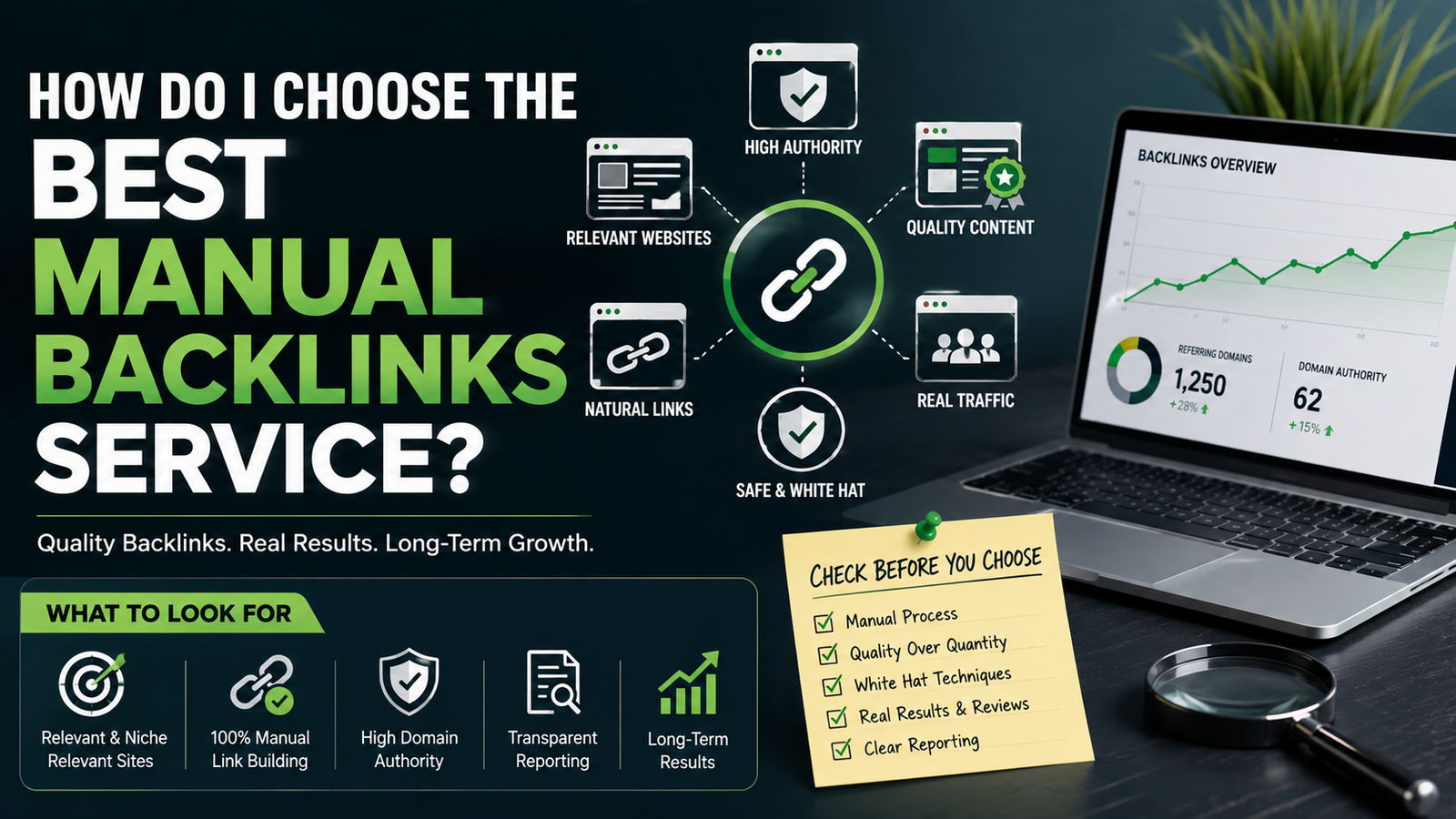
Guide to choosing a manual backlinks service with relevant websites, quality links, white-hat SEO, authority, and transparent reporting.

How Do I Choose the Best Manual Backlinks Service

Not all backlinks work the same way. Pick the wrong provider, and your rankings can drop instead of rise. A real manual backlinks service builds links the old-fashioned way. Real people reach out. Real relationships form. Nobody dumps your site into a spam network overnight. This guide breaks down what separates a solid provider from a risky one. You will learn what to look for. You will also learn how to avoid wasting money on links that do nothing at all. What Makes Manual Link Building Different Automated tools can churn out thousands of links in a day. But Google caught on to that trick years ago. Sites using it often get penalized eventually. Manual backlink building works differently. A real person researches relevant websites. They reach out directly. They earn a placement based on real value. That might be a guest post. It might be a resource to mention. It might be a natural editorial link. This difference matters more than people think. Search engines have gotten better at spotting automation. They notice identical anchor text on low-quality sites. They notice links appearing in bulk overnight.  A manual link building service avoids these red flags. Every placement gets checked by a human first. So yes, it takes longer. But the results tend to stick around, even after the next algorithm update. What To Look For In A Quality Provider Check transparency first. A trustworthy provider tells you which sites they are pitching. They explain the domain authority. They walk you through the outreach process. If a provider stays vague about where your links come from, that is a warning sign. If they refuse to share past placements, walk away. Relevance matters just as much as authority. A link from an unrelated site does little for your rankings. A link from a site your audience actually trusts does far more. So, before you decide to buy manual backlinks, ask how they match opportunities to your niche. Do they chase relevance, or just chase the highest number they can find? Pricing tells its own story too. Rock-bottom rates for bulk packages usually mean corners got cut somewhere. That might mean low-quality sites. It might mean thin content. It might mean links buried on pages nobody visits. A fair price reflects real time and real effort. Genuine outreach cannot get rushed or mass-produced. Red Flags That Signal A Risky Service A few warning signs show up again and again. Guaranteed rankings within a set timeframe top the list. No legitimate provider can promise results Google itself does not guarantee. Packages offering hundreds of links for almost nothing usually involve link farms. These carry real penalty risk. Watch for providers who dodge questions about their process too. If a company will not explain where links come from, that vagueness usually hides shortcuts. A legitimate manual backlinks service welcomes these questions instead of avoiding them. How To Know If Your Backlinks Are Actually Working Tracking results takes patience. Manual link building rarely delivers overnight jumps. Watch your domain authority and organic traffic over months, not days. Check whether new referring domains actually fit your niche. Random unrelated sites do not help much. Google Search Console gives you a simple way to monitor which backlinks are indexed and adding real value over time. Choosing The Right Partner For Long-Term Growth Finding the right manual backlinks service takes patience. It takes transparency. It takes choosing quality over shortcuts that put your site at risk.  A provider who explains their process, shows real examples, and sets honest expectations is worth far more than one promising instant results nobody can deliver.  14K Business Solutions builds manual backlink building strategies around real relevance and lasting authority. No shortcuts. No links that vanish the moment Google updates its algorithm. Frequently Asked Questions Is a manual backlinks service safe for SEO? Yes, when done right. Real people vet each placement individually. This avoids the spammy patterns that trigger Google penalties. It makes manual link building a safer long-term strategy than automated or bulk link schemes. How much does a manual backlinks service cost? Pricing varies. It depends on your niche, site authority, and how much outreach the job needs. Expect to pay more than you would for automated alternatives. Quality outreach takes real time, and that shows up in the price of a legitimate provider. How long does a manual backlinks service take to work? Most businesses see measurable movement within three to six months. This depends on your competition and how consistently new links get added. Manual link building builds authority slowly. It does not deliver instant spikes. Can a manual backlinks service improve Google rankings? Yes, especially when links come from relevant, authoritative sites earned through real outreach. Quality backlinks remain one of the strongest ranking factors Google uses. That makes manual link building a smart long-term investment for most sites.

Read More »
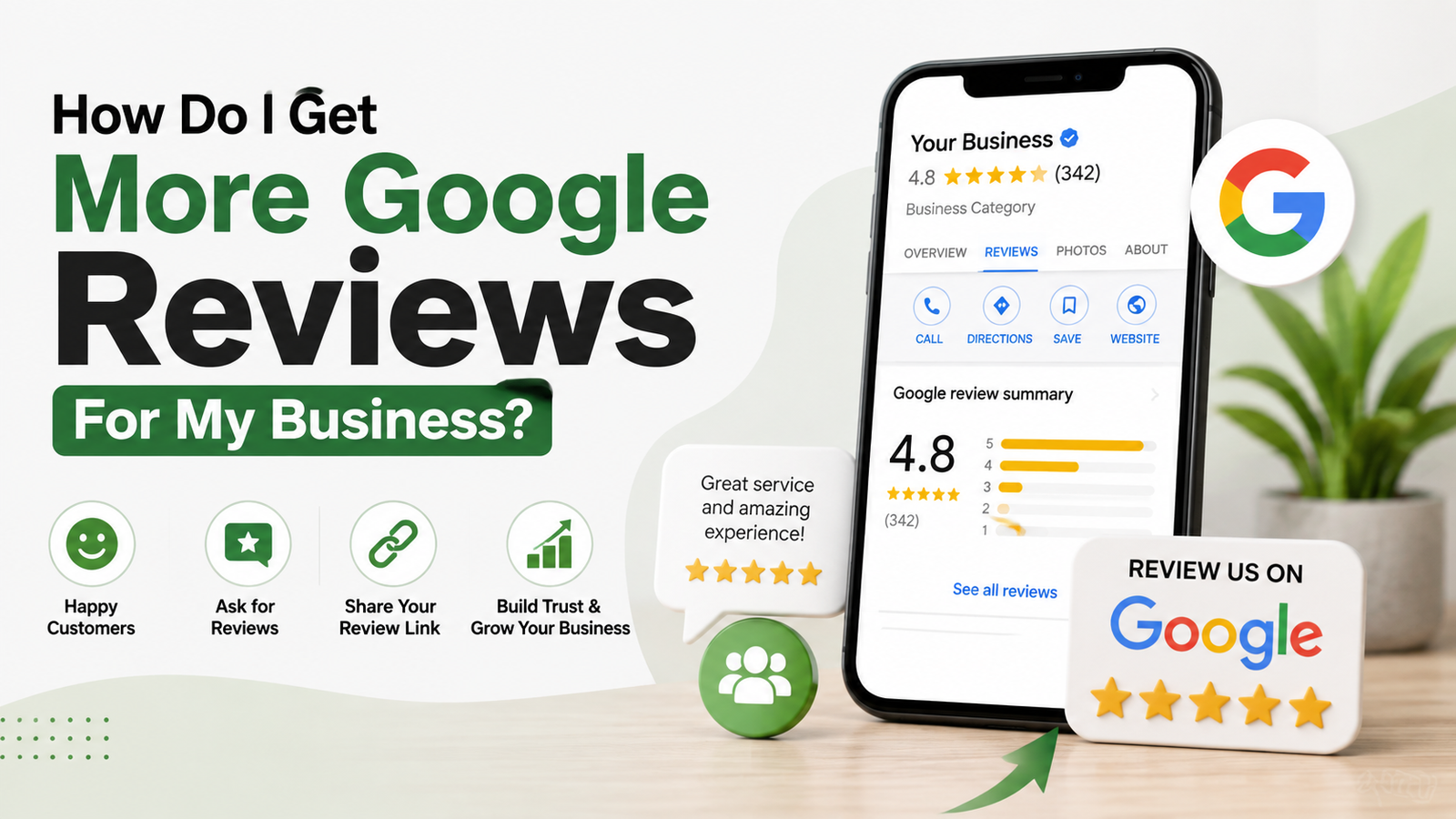
A modern infographic showing how businesses can get more Google reviews using customer feedback, review links, and trust-building strategies.

How Do I Get More Google Reviews For My Business?

Picture a potential customer searching online for a local service. Two options pop up immediately at the top of the search results. One business has four stars with three outdated ratings. The other boasts a 4.9-star rating with over two hundred enthusiastic write-ups. Which shop gets the phone call? The answer is obvious. In 2026, online feedback acts as digital word-of-mouth. It directly drives purchasing decisions and local search rankings. If your company struggles to collect feedback online, you are missing opportunities to attract new customers. Learning how to get more Google reviews is one of the fastest, most cost-effective ways to build public trust and beat local competitors. At 14K Business Solutions, we specialize in helping brands optimize their digital presence. Our goal is to help you capture high-intent local clients. Let’s look at why public feedback matters so much and explore proven strategies to build a more consistent review process. The Power of Online Feedback for Local Visibility When customers search for local solutions, search engines prioritize trust and proximity. Positive feedback can strengthen the trust signals associated with your local presence. In turn, a steady flow of reviews can help customers feel more confident about choosing your business. Consequently, building a steady flow of Google reviews for business growth directly improves your visibility in local map packs and organic search rankings. Furthermore, feedback impacts your broader digital reputation. Public ratings validate your expertise and make your paid ads and social campaigns far more persuasive. When shoppers see consistent praise from their neighbors, their buying friction drops instantly. Optimize Your Digital Storefront First Before asking clients for feedback, your public profile must be fully optimized and easy to navigate. Having a verified, complete profile ensures a smooth experience for your customers. When they click your feedback link, they land directly on a clean, functional rating page without any technical hiccups. Managing your Google Business Profile reviews effectively requires consistent maintenance: Overall, taking care of these core profile elements sends a strong message. It shows potential buyers and search algorithms that your business is responsive, professional, and reliable. Simple Strategies to Collect Feedback Daily People are busy, and unless you make the process frictionless, even your biggest fans will forget to post. Knowing how to get more Google reviews simply comes down to asking at the right moment through the right channels. 1. Ask Right at the Peak Moment of Satisfaction First, timing matters. Ask for feedback soon after delivering a great result, finishing a successful service, or closing a smooth sale. The customer’s enthusiasm is highest right at that moment. 2. Send Short, Direct SMS and Email Follow-Ups Send a polite text message or email shortly after their service. Include a direct link that opens the rating window with a single tap. ·         Step 1: Thank the client for choosing your service. ·         Step 2: Include a direct 1-click link to your review page. ·         Step 3: Keep the message under 3 sentences for maximum readability. 3. Use Physical Touchpoints and QR Codes Finally, if you operate a physical store or office, display printed QR codes at your checkout counter, on receipts, or on business cards. A simple callout like “Loved your experience? Scan here to let us know!” encourages immediate action while the visit is still fresh. Boost Your Search Rankings with Off-Page Optimization Collecting customer feedback is a core pillar of effective off-page SEO. On-page search engine optimization handles your website’s content and structure. Off-page strategies, on the other hand, build your website’s overall authority and local trust across the web. Integrating consistent client ratings into your broader local strategy sends undeniable trust signals. These signals go directly to major search algorithms. As a result, a strong reputation and broader off-page SEO efforts can support your visibility in competitive local searches. Managing Negative Feedback Like a Pro Fearing a bad review holds many owners back from asking for feedback altogether. Receiving an occasional low rating is completely normal. It actually allows you to show your accountability. However, when a negative comment appears, respond quickly and professionally. Acknowledge their frustration and apologize for any shortfall. Then take the conversation offline by offering a direct phone number or email address. When potential clients see you handle complaints with grace, their trust in your brand actually grows. Maintaining high-performing Google Business Profile reviews isn’t about hiding flaws; it’s about showcasing your dedication to top-tier customer care. Partner with 14K Business Solutions for Total Digital Growth Consistently generating Google reviews for business success requires systematic processes, strategic communication, and ongoing profile management. Trying to handle manual outreach while managing daily operations can quickly become overwhelming. As a leading digital marketing company in Philadelphia, 14KBSol builds comprehensive growth engines that turn satisfied clients into vocal brand advocates. Our expert team handles the technical heavy lifting. Our expert team handles the technical heavy lifting, from automated feedback workflows to complete local search optimization. As a result, you can focus more of your time on serving your growing client base. At 14K Business Solutions, we combine local SEO, reputation management, and digital marketing strategies to help businesses grow online. Ready to dominate your local market, boost your search rankings, and attract more high-value clients? Reach out to 14K Business Solutions today to craft a customized reputation strategy designed specifically for your brand!

Read More »
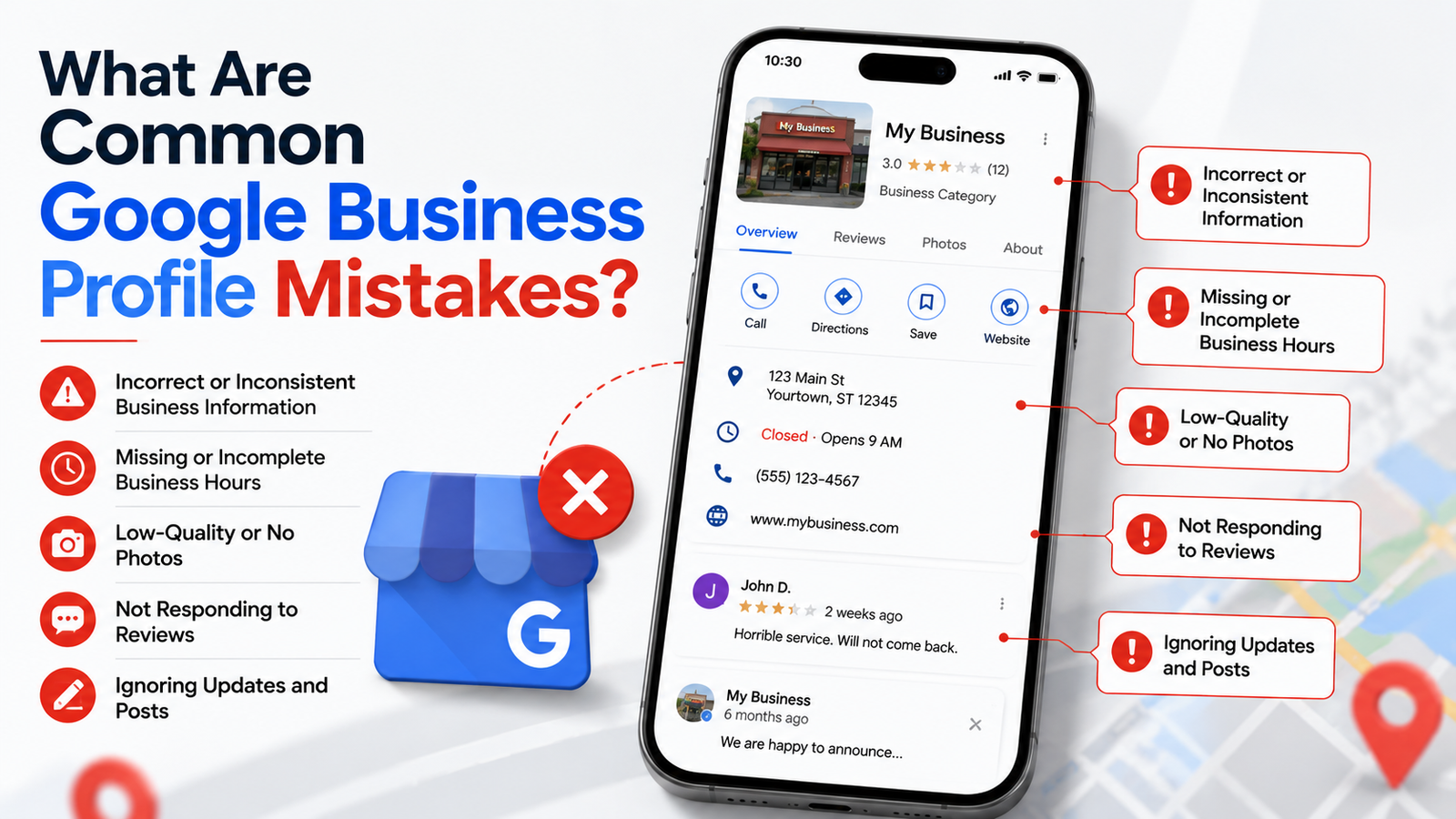
Common Google Business Profile mistakes including incorrect business information, missing hours, poor photos, ignored reviews, and outdated posts.

What Are Common Google Business Profile Mistakes?

Ever wondered why your local competitors consistently show up in the top three map results on Google? Meanwhile, your business is nowhere to be found in the local map pack. It’s rarely just luck or a bigger ad budget. More often than not, it comes down to a few sneaky, overlooked errors right on your local listing. When people search for help nearby, they glance at local business profiles before making a single call. If your listing has conflicting info or missing details, prospective clients will scroll right past you. They will move on without a second thought. Fixing common Google Business Profile mistakes is easily one of the quickest ways to regain visibility and turn casual searches into paying clients. At 14K Business Solutions, we review local listings every day to identify issues that hurt visibility and reduce conversions. Let’s walk through the most frequent profile errors business owners make and how fixing them can transform your online reach. The Trap of Inconsistent Contact Info The cornerstone of local search trust is data consistency. Search engines cross-reference your business name, physical street address, and phone number across online directories, maps, and social platforms. If your listing says “Main Street” while your site lists “Main St,” search engines take notice. The same applies to old phone numbers floating around online. These inconsistencies causeGoogle may have less confidence in your business information. Eliminating these basic discrepancies is essential for effective Google Business Profile SEO. Making sure your core details match word-for-word across the web keeps your listing reliable and easy to find. Getting Your Categories Right and Keeping Details Fresh Your primary category selection heavily influences which local searches trigger your profile. Picking something overly broad, like choosing “Consultant” instead of “Business Management Consultant,” confuses search algorithms. On the flip side, packing your profile with dozens of loosely related extra categories dilutes your focus. A smart approach to Google Business Profile optimization starts with choosing a laser-accurate primary category. It should reflect your main service and be backed by just a few precise secondary choices. At the same time, treating your profile like a one-and-done task is a major misstep. Search platforms favor businesses that stay active. Adding recent photos helps customers understand what your business offers and keeps your profile looking current. Ignoring reviews creates another huge roadblock. Leaving positive feedback without a reply tells potential clients you are not paying attention. Skipping over negative reviews lets complaints define your reputation. Duplicate profiles can also create problems. Google allows only one Business Profile for each eligible business, and duplicate listings may not appear properly in Search or Maps. Once you’ve resolved any duplicate listings, replying to customer reviews regularly is an important part of Google Business Profile SEO and helps keep your profile active and trustworthy. Connecting Your Profile to a Larger Strategy Fixing your Google Business Profile is a great first step, but it shouldn’t be the only thing you rely on. A strong local SEO strategy works best when your profile, website, reviews, and other marketing efforts all support each other. Your profile works best when it ties into a broader, well-rounded marketing effort. For instance, running targeted Facebook ads builds local awareness right in your target zip codes. This drives warm traffic directly to your profile. Strong link-building strategies can improve your website’s authority and support the prominence signals connected to local visibility. Pairing a clean local listing with targeted campaigns creates a steady stream of leads. This is what sets you apart from regional competitors. Frequently Asked Questions How can I improve my Google Business Profile ranking? It all comes down to consistent Google Business Profile optimization. Start by double-checking your contact info for total accuracy and picking the right categories. Post fresh photos regularly and respond to customer reviews. Also, make sure you are linking directly to a fast, mobile-friendly website. Does an incomplete Google Business Profile affect local SEO? Absolutely. An incomplete profile does not give search engines enough information to match you with relevant local searches. Missing service areas, incomplete descriptions, or inaccurate hours give Google less information to match your business with relevant local searches. This can hurt your visibility in local search results. What are the most common Google Business Profile mistakes that hurt local rankings? The biggest Google Business Profile mistakes we see fall into a few common patterns. These include inconsistent contact details across directories, picking incorrect primary categories, and ignoring customer reviews. Forgetting to update photos and having accidental duplicate listings for a single location are also frequent issues. Dominate Your Local Market with 14K Business Solutions LLC Finding hidden listing errors and keeping up with regular updates takes time and technical precision. When you’re busy running a business, keeping up with local search updates can get overwhelming fast. As a premier Digital marketing company in Philadelphia, 14K Business Solutions LLC handles local search management so your brand gets noticed. From fixing listing data to pulling in targeted local traffic, our team handles the technical work so you stay visible at the top of search results. Plus, our parent team at 14K Business Solutions LLC combines high-level growth guidance with tailored search strategies to build your long-term online presence. Ready to clear out listing errors, improve your local rankings, and bring in new clients consistently? Get in touch with 14K Business Solutions today for a complete local profile audit!

Read More »
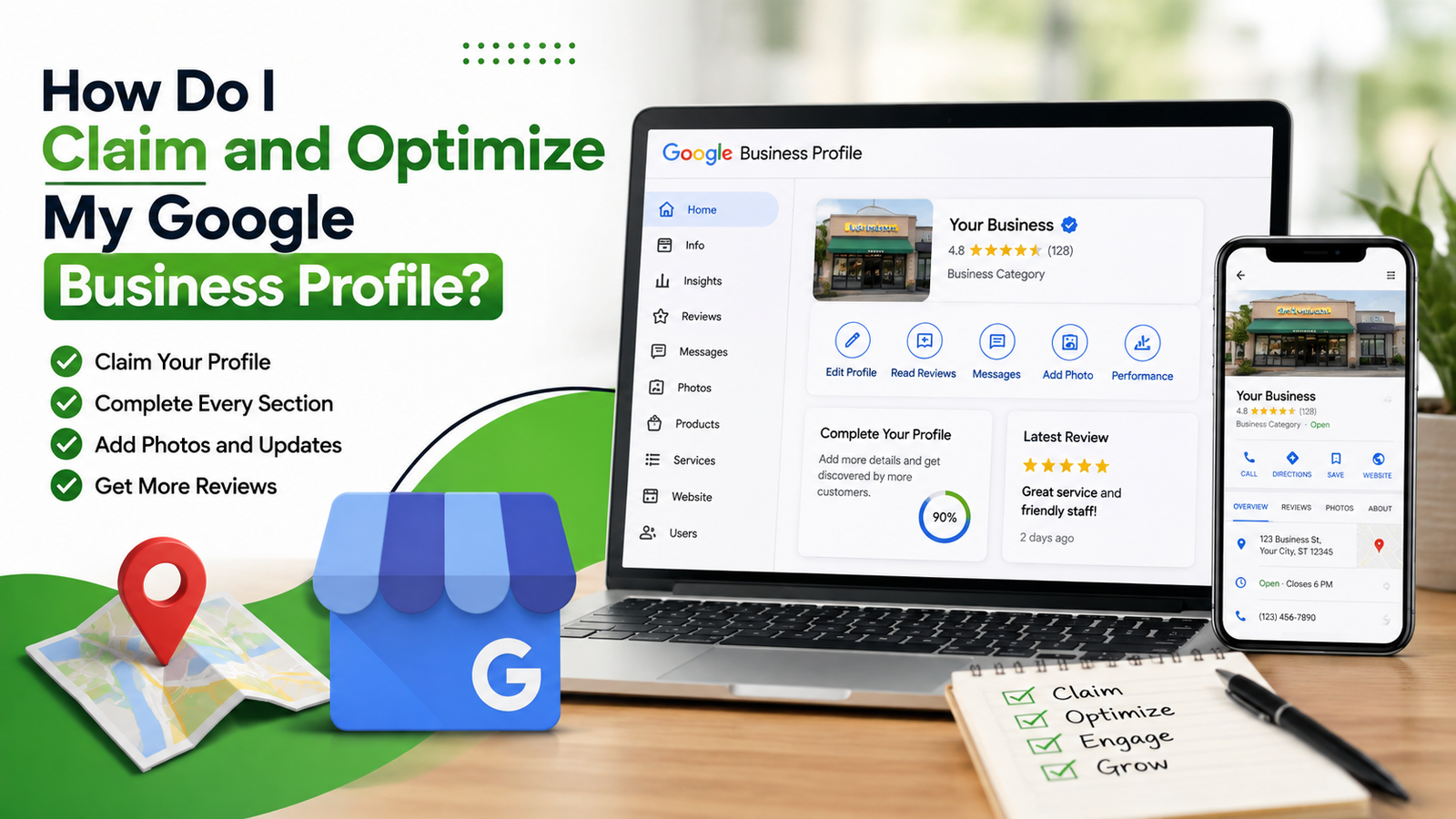
Google Business Profile dashboard on a laptop and phone showing profile optimization, reviews, photos, business details, and local search tools.

How Do I Claim and Optimize My Google Business Profile?

For a local business, being visible when someone searches for your services online can make a major difference. A potential customer might search for a restaurant nearby, a marketing agency in their city, or a contractor they can trust. In many of these searches, Google Business Profiles appear before traditional website results, giving businesses an important opportunity to attract attention. But simply creating a profile is not enough. Businesses need to make sure their information is accurate, their profile is complete, and their listing provides useful information to potential customers. This is where Google Business Profile Optimization becomes important. A properly optimized profile can help customers discover your business, understand what you offer, read reviews, find your location, and contact you. For local businesses competing for attention, it can become one of the most valuable parts of a broader local SEO strategy. What Is a Google Business Profile? A Google Business Profile is a free business listing that allows companies to control how their information appears across Google Search and Google Maps. It can display important details such as the business name, address, phone number, website, hours, services, photos, reviews, and other information. Think of it as your business’s digital storefront on Google. Even if someone has never visited your website, they may encounter your company through its profile while searching for a product or service. Because customers often use Google to make quick purchasing decisions, keeping this information accurate and useful is essential. How Do I Claim My Google Business Profile? The first step is to find your business on Google and check whether a profile already exists. Businesses should avoid creating duplicate listings if an existing profile is already associated with the company. Once you locate the profile, you can follow Google’s verification process to claim ownership. Google may require verification through an available method to confirm that you are authorized to manage the business. After verification, you gain access to the profile’s management features. This allows you to update business information, add photos, respond to reviews, manage services, and make other changes. If your business has recently moved, changed its phone number, or updated its services, claiming the profile is particularly important because outdated information can create confusion for customers. Complete Every Important Section Once your profile is claimed, the next step is completing it as thoroughly as possible. Businesses sometimes add their name, address, and phone number and leave everything else unfinished. That means customers may not get a complete picture of what the business offers. Add an accurate business description, relevant categories, services, hours, website, phone number, and other available information. Make sure everything matches the information presented on your website and other important business directories. Completeness is not about stuffing the profile with keywords. It is about making the listing genuinely useful to people who are considering your business. Choose the Right Primary Category Your primary business category helps Google understand what your business does. It also helps determine when your profile may be relevant to local searches. Choose the category that most accurately represents your core business rather than selecting a category simply because it contains a popular keyword. Depending on the business, additional relevant categories may also be available. However, these should accurately describe your services and not be added simply to increase visibility. A clear and accurate category gives Google stronger context about your business and helps potential customers understand what you offer. Write a Helpful Business Description Your business description is another opportunity to communicate what makes your company different. Instead of filling the description with repetitive keywords, write naturally about your services, customers, experience, location, and value proposition. Think about what a potential customer would want to know before contacting you. For example, a local service provider could explain the areas it serves, the types of projects it handles, and what customers can expect from working with the company. Good copy should sound like a real business speaking to real customers, not a search engine trying to manipulate rankings. Add High-Quality Photos Regularly Photos can make a profile significantly more engaging. Customers want to see what a business looks like, what it offers, and what they can expect when they visit or work with the company. Businesses can add exterior and interior photos, products, completed projects, team images, and other relevant visuals. For service businesses, photographs of completed work can be particularly useful because they provide potential customers with a visual sense of the company’s capabilities. Fresh, authentic images can also make a profile feel active rather than neglected. Build and Manage Customer Reviews Reviews are an important part of a strong local presence. Customers often read reviews before deciding whether to contact a business, especially when comparing several local options. Encourage genuine customers to leave honest feedback after working with your business. More importantly, respond to reviews professionally, including negative ones. A thoughtful response to a negative review can demonstrate that the business takes customer concerns seriously. Positive reviews should also receive responses rather than being ignored. The goal should not simply be collecting as many reviews as possible. Businesses should focus on providing excellent experiences that naturally encourage customers to share their feedback. Use Google Business Profile SEO Strategically Google Business Profile SEO involves improving your profile so that it is more useful to both Google and potential customers. This includes maintaining accurate information, choosing appropriate categories, adding relevant services, publishing useful updates, managing reviews, and keeping the profile active. Local search visibility is influenced by several factors, and no single optimization guarantees a top position. Instead of chasing quick tricks, businesses should focus on building a complete and trustworthy local presence. Your Google Business Profile should also complement your website. Business information should remain consistent across your website, profile, and other reputable online listings. Keep Your Profile Updated Optimization is not a one-time task. Business information changes over time, and an outdated profile can quickly become less useful. Update holiday hours, new services, photos, business

Read More »
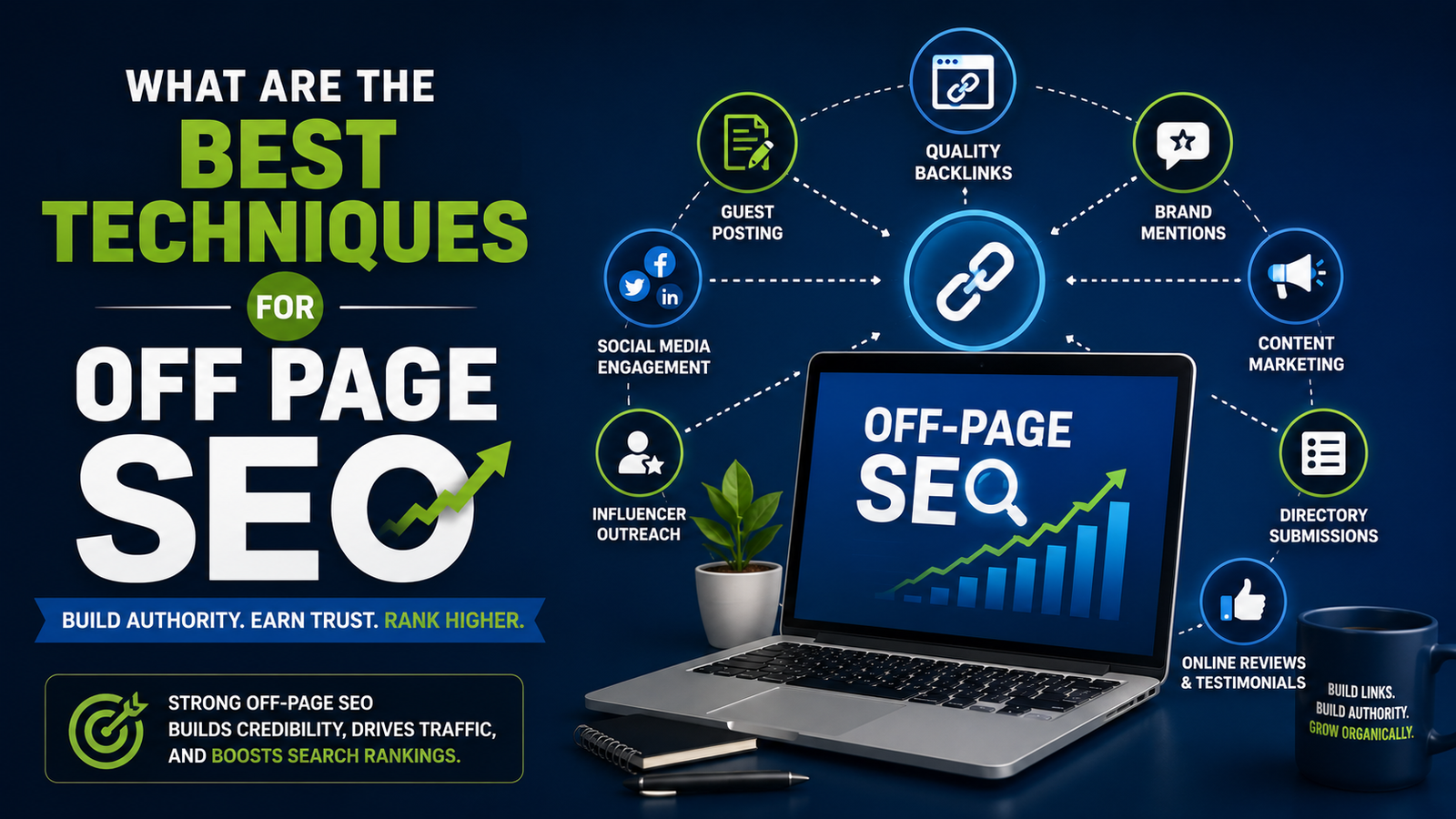
Digital illustration of off-page SEO techniques featuring backlinks, guest posting, brand mentions, social media, content marketing, online reviews, and link building.

What Are the Best Techniques for Off Page SEO?

A website can look flawless on the surface and still fail to rank. It happens simply because nobody outside that site is vouching for it. Search engines rely heavily on external signals to decide who deserves top rankings, and that reality hasn’t changed even as AI reshapes search. Local SEO optimization remains an important aspect of off-page SEO techniques. So, understanding which strategies genuinely build authority matters more than ever if you want your content to get found and trusted. What Off Page SEO Really Means Your website tells search engines what you say about yourself. Meanwhile, off-page SEO covers everything other people and other websites say about you. This includes backlinks, brand mentions, digital PR, social signals, and local citations that collectively signal trust and credibility. Off-page SEO covers activity performed outside a website, including high-quality backlinks, brand mentions, digital PR, social signals, local citations, and reviews. These signal trust and authority to search engines and increasingly to AI systems. Naturally, this makes off-page work fundamentally different from optimizing your own pages. On-page SEO helps search engines understand your content. Off-page techniques SEO helps prove that content deserves to rank in the first place. Neither one works well without the other, since a technically flawless site with no outside authority will still struggle against competitors. Why Off-Page Techniques SEO Still Drive Rankings Some marketers assume AI search made local SEO optimization less relevant, but the data says otherwise. In fact, a large majority of SEO professionals believe backlinks influence whether a site gets cited in AI-generated search results. This means the same off-page techniques in SEO that built traditional rankings now also shape visibility inside ChatGPT, Gemini, and Perplexity answers. High-quality backlinks still beat quantity by a wide margin. A single link from a relevant, high-authority site tends to outperform dozens of low-quality links combined. Therefore, chasing large numbers of weak links wastes time that would be better spent earning fewer, stronger ones. Patience matters too, since most off-page SEO techniques need several months of consistent effort before rankings shift in any noticeable way. Link Building Strategies That Actually Work Effective link building strategies start with creating something genuinely worth linking to. Original research, comprehensive guides, and useful free tools tend to attract links passively over time, since other sites want to reference credible, well-researched sources. Once you have that kind of content, reaching out to relevant publications becomes far easier. Guest posting remains valuable when done thoughtfully. Writing genuinely useful articles for respected sites in your industry, then linking back naturally, still earns solid authority. Additionally, broken link building offers a practical opportunity. Finding outdated links on high-traffic pages and offering your own content as a replacement benefits both sides. Brand mention tracking rounds out a strong strategy. Converting unlinked mentions of your business into real backlinks recovers authority, you’re already halfway to earning it. Earning High-Quality Backlinks Without Cutting Corners Not every backlink helps your site, and honestly, some can do real damage. Search engines have gotten much better at spotting manipulation, so shortcuts like private blog networks or mass directory submissions aren’t worth the risk anymore. What actually works is getting links from sites that already have credibility, places that would genuinely reference your content because it’s useful, not because you paid for the placement. A varied backlink profile matters more than people realize. Picking up links from industry blogs, a university resource page, a government site, or a respected local directory creates a mix that looks natural because it is natural. Businesses chasing editorial placements instead of manufactured link schemes end up with authority that survives the next algorithm update, while the shortcut takers usually don’t. Why Local Signals Carry So Much Weight If you run a local business, off-page work looks a little different, and in some ways it matters even more. A well-kept Google Business Profile does a lot of heavy lifting here, but it only works alongside citations that stay consistent everywhere your business shows up online. Your name, address, and phone number need to match across every directory, because inconsistency quietly erodes the trust search engines place in your listing. Reviews carry real weight too, and not just as a trust signal for search engines. Customers actually read them before they decide who to call. A steady stream of genuine reviews, updated regularly rather than in one big batch, tends to perform better than a pile of five-star ratings from three years ago. On top of that, local backlinks carry extra influence for service area businesses, especially links from community groups, local news coverage, or regional business associations that already have the trust of people nearby. Where To Start If You’re Building This From Scratch Start with whatever content you already have that people would actually want to link to. It can be a guide you wrote, some original research, or a free tool on your site. Build a short list of relevant sites worth reaching out to about it, then begin working on local SEO optimization from there. Once that’s moving, layer in social engagement, keep an eye on brand mentions, and stay on top of local citation management so nothing slips out of sync. At the end of the day, the businesses that win at local SEO optimization aren’t manufacturing attention. They’re earning it, one relationship and one genuinely useful piece of content at a time. That’s true whether you’re trying to rank in Google or get cited inside an AI-generated answer, since both systems are ultimately looking for the same thing, proof that people trust you. Frequently Asked Questions Is off-page SEO still relevant? Yes, and honestly more than ever. Off-page signals now shape not just traditional rankings but also whether AI tools mention your brand when someone asks a related question. Businesses that skip this work tend to plateau, even when they have on-page content. How do I improve my off-page SEO? Start by creating something worth linking to, then reach out to relevant sites about

Read More »
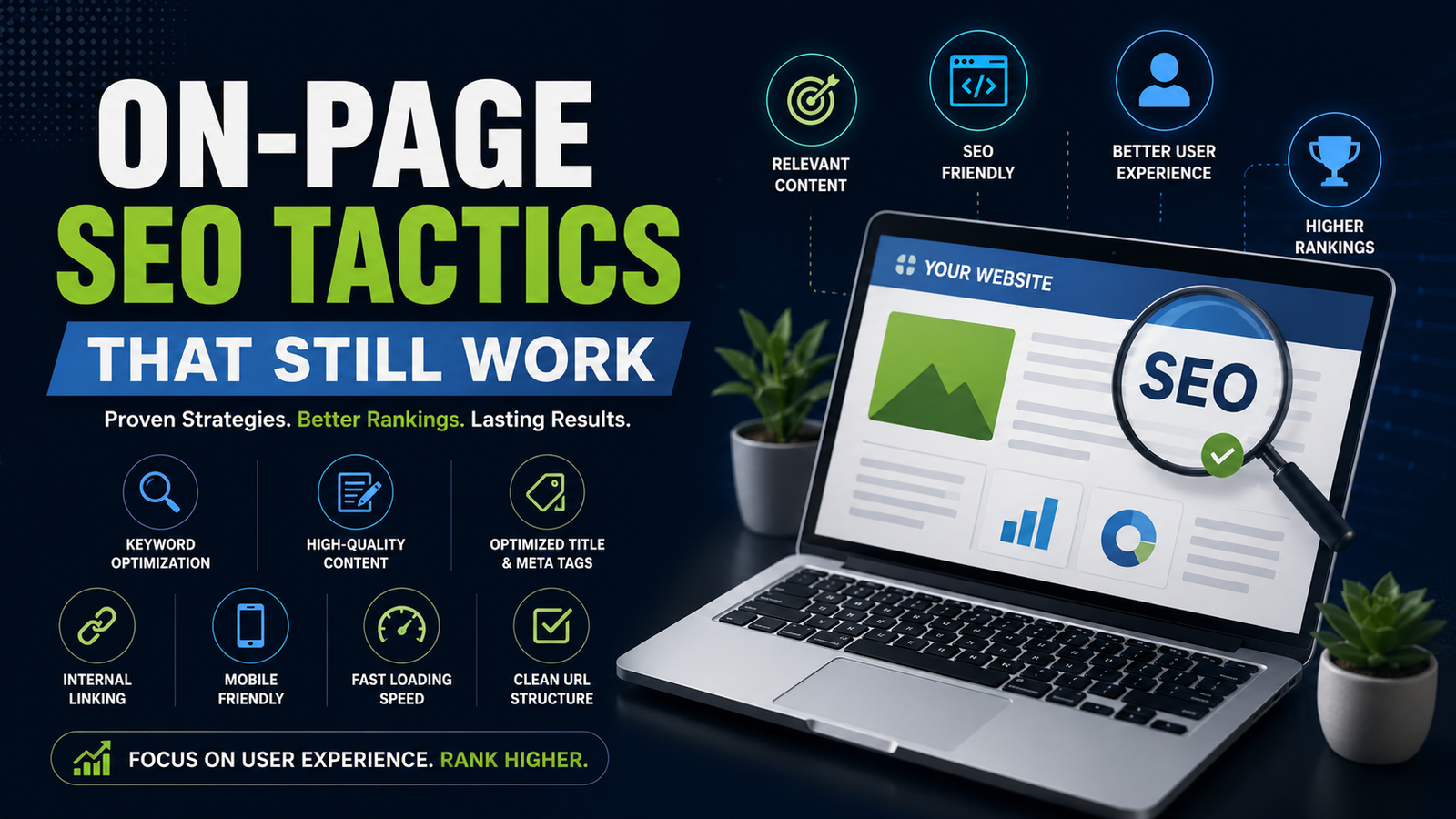
Illustration of on-page SEO tactics featuring keyword optimization, quality content, meta tags, internal linking, mobile-friendly design, and SEO analytics.

On-Page SEO Tactics That Still Work

Most websites do not lose rankings because Google changed everything overnight, they lose it because they abandoned tactics that never stopped working. Meanwhile, marketers chase every algorithm rumor while ignoring the on-page fundamentals sitting right in front of them. So, this guide breaks down exactly which tactics still deliver results in 2026. Moreover, how to apply them without wasting time on trends that never mattered much to begin with. On Page SEO Techniques Google Still Rewards Search engines process content far more intelligently than they did a few years ago. Yet certain on page SEO techniques remain just as important now as they were back then. Firstly, the title tags placed near sixty characters and meta descriptions written with a clear call to action weigh a lot for SEO. Also, header tags organized in a logical hierarchy still shape how well a page performs. Beyond that, page speed and mobile responsiveness carry real weight in ranking decisions. Interaction to Next Paint replaced older speed metrics. Similarly, pages that load sluggishly on mobile devices routinely lose ground to faster competitors. Consequently, technical health and content quality now function as two halves of the same ranking equation rather than separate priorities. Crafting a SEO Content Strategy That Actually Converts Evidently, good content starts with understanding what a searcher truly needs. The results do not depend anymore on what words they typed into the search bar. A solid SEO content strategy groups related keywords around a single, well-developed page instead of scattering thin content across dozens of near duplicate posts. This approach signals topical depth, which search engines and AI systems both reward. Additionally, placement matters just as much as frequency. Your primary keyword should appear naturally within the opening paragraph, and supporting terms should surface throughout the body without feeling forced. Every section should answer the question its heading implies right away, since readers skim before they commit to reading in full. From there, seo content optimization becomes an ongoing process of refreshing pages that lose traffic rather than a onetime task you finish and forget. Learning to Optimize Content for Google AI Overview Placements AI generated summaries now appear across a growing share of search results. Ignoring them means giving up visibility and you can’t easily win back elsewhere. Therefore, learning to optimize content for google AI overview results has quietly become part of standard on page work. Content written in clear, self-contained sections tends to get pulled into these summaries more often than content that buries answers deep in long paragraphs. Schema markup plays a supporting role here too. FAQ schema and article schema give search engines structured signals about what a page covers, which makes it easier for AI systems to extract accurate information. Since these systems favor evidence-backed, factual writing, vague claims without support rarely earn a citation. Why Internal Linking Strategy Deserves More Attention Internal links often get overlooked, yet few tactics deliver returns this reliably. A well-planned internal linking strategy connects related pages, spreads ranking authority across your site, and helps both visitors and search crawlers understand how your content fits together. Sites that link generously between relevant pages consistently outperform those that treat every post as an island. A practical on page SEO checklist should include three to five internal links per thousand words. Each using descriptive anchor text rather than generic phrases like click here. Image optimization deserves a place on that checklist too. Many websites still skip descriptive alt text entirely, even though image search accounts for a meaningful share of overall search volume. Compressing file sizes and writing complete, descriptive alt text improves both accessibility and visibility. Local SEO Optimization for Location-Based Businesses Businesses that serve a specific city or neighborhood have to face a different set of challenges compared to brands that deal nationwide. In such scenarios, local SEO optimization remains essential here. AI assistants and traditional search results both rely on accurate, consistent business information to make local recommendations. Inconsistent addresses or outdated phone numbers across directories quietly damage visibility over time. Furthermore, content built around real local questions performs noticeably better than generic service pages. Customer reviews, service area pages, and neighborhood specific details all help search engines and AI systems understand exactly who a business serves and where. Businesses that keep this information current tend to show up far more often when nearby customers go looking. Final Thoughts Lastly, on-page SEO hasn’t lost its value, and the businesses treating it as outdated are the ones falling behind fastest. Instead, the discipline has grown more demanding, rewarding sites that combine technical precision with genuinely useful, well-organized content. Hence, the companies that master these fundamentals while adapting to how AI systems read and cite information will keep earning visibility no matter how search continues to evolve. If your business needs a content strategy built for how people actually search in 2026, the team at 14K BSol can help you put one together. Frequently Asked Questions What is the 80 20 rule of SEO? The 80 20 rule is a great rule of SEO. It divides the segment, a small portion of your pages, which make up to 20 percent, generate the majority of your organic results. Identifying which pages already perform well and doubling down on optimizing them tends to produce far better returns than spreading effort evenly across your entire site. What are the 3 C’s of SEO? The 3 C’s mean content, code, and credibility. Content covers if your pages genuinely satisfy what the searchers need. Code refers to the technical foundation that allows search engines to crawl and interpret your site correctly. Credibility involves the trust signals and authority that convince both search engines and AI tools to recommend your business. What are the top 5 SEO strategies? The strategies that consistently deliver results include keyword research. It is also built around real intent and on-page optimization covering titles and headers. Meanwhile, technical performance improvements like faster load times, quality backlink building, and regular content updates.

Read More »
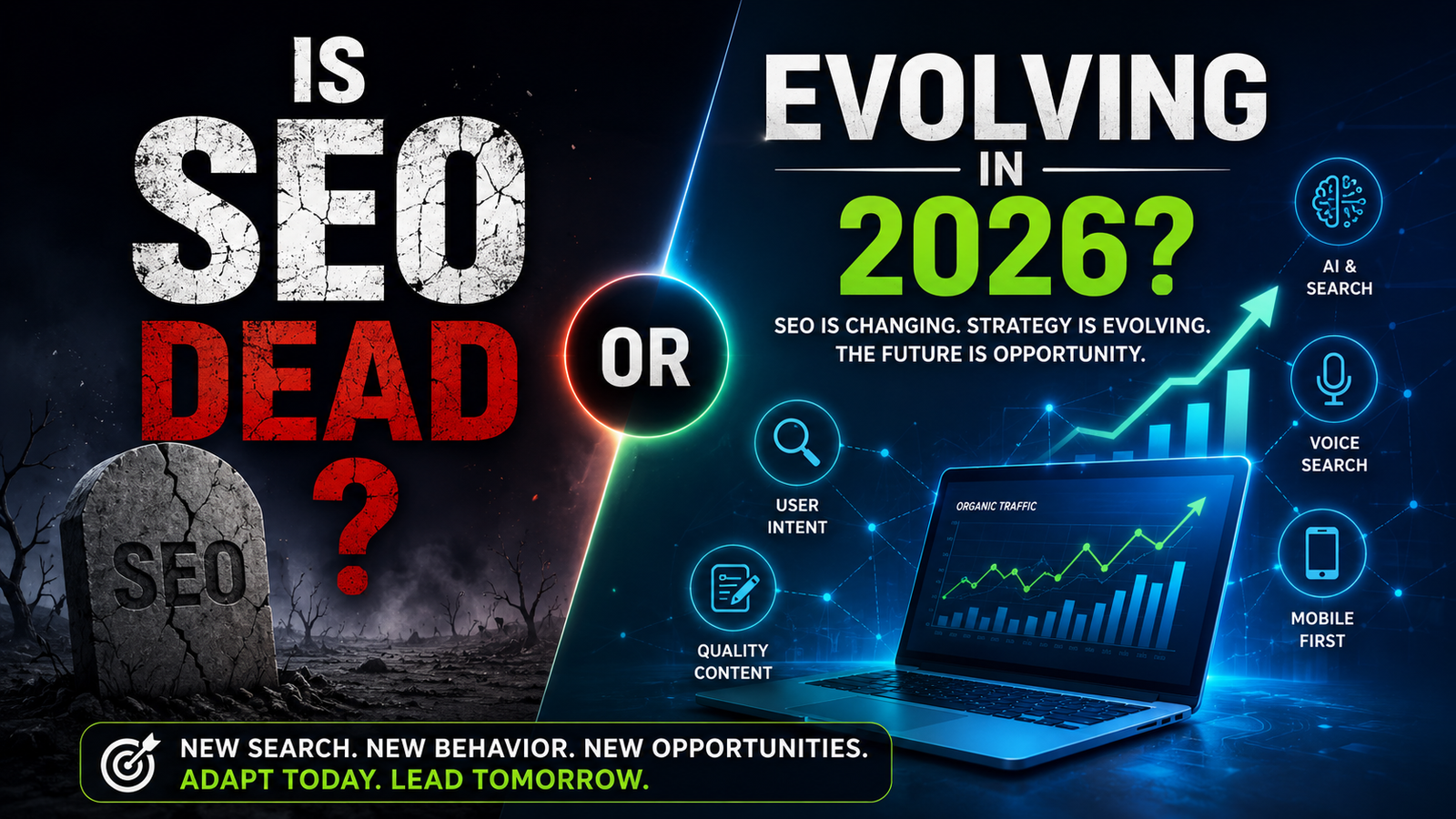
Split-screen illustration showing SEO evolving in 2026 with AI, analytics, user intent, voice search, mobile-first optimization, and organic traffic growth.

Is SEO Dead or Evolving in 2026?

Search engine optimization (SEO) refuses to die, but it barely resembles the SEO we knew five years ago. Ask any marketer who watched their organic traffic dip while their brand mentions in ChatGPT answers climbed. These are the people who will tell you something shifted. So, the real question isn’t whether SEO in 2026 survives. The real question is whether your strategy has caught up with where search actually happens now. Truth Behind the SEO Death Debate Plenty of headlines claim SEO is dead, and honestly, the panic makes sense on the surface. AI Overviews now answer a huge share of Google queries before users ever click a link. Meanwhile, people are asking Perplexity, Gemini, and ChatGPT questions they once typed into a search bar. Naturally, click-through rates for traditional organic listings have dropped in queries where AI summaries appear. However, the data tells a more nuanced story. AI models still pull their answers from indexed, crawlable web content. Therefore, strong technical SEO still determines whether your site even gets considered as a source. Consequently, generative engine optimization builds directly on top of traditional SEO rather than replacing it. Google itself still processes trillions of searches a year, and most of those searches never trigger an AI Overview at all. So, SEO isn’t dying. It’s splitting into a wider discipline that covers search engines, answer engines, and AI chat platforms all at once. How AI Search Optimization Is Reshaping Rankings AI systems don’t rank pages the way Google’s algorithm does. Instead, they take information from multiple sources and generate a single answer. It means visibility now depends on being cited, not just being clicked. An effective AI search optimization approach focuses on clarity, structure, and extractability. All AI models favor content that they can quote and summarize without confusion. Today, trust signals matter more than ever. LLM systems weigh authorship, expertise, and source credibility before deciding what to cite in a response. This aligns with Google’s E-E-A-T principles. Regardless of all the changes, backlinks still carry weight. AI tools rely on live web search and public datasets to find and trust signals. For that reason, businesses now invest heavily in LLM optimization. It means writing content that large language models can understand, verify, and reuse safely. Structured headings, direct answers, and factual accuracy all play a role here. Building a Smarter SEO Content Strategy for 2026 The new SEO content strategy treats every page as an answer to a real question. It is no longer just a keyword target. To start, content needs semantic depth. It means content should cover related subtopics a reader or an AI model would naturally ask about. Second, every page should include direct, well-organized answers near the top, since AI systems often extract specific sections rather than entire articles. Furthermore, AI SEO strategy planning now includes tracking visibility across ChatGPT, Perplexity, and Gemini, not just Google Search Console. Nowadays, businesses are testing their own brand queries across platforms. They are testing to see how they get mentioned and how accurately they are described. Once you know what and where you are missing, you can adjust your content and close that gap. Eventually, SEO in 2026 rewards brands that publish original insight, cite real data, and avoid generic filler that adds nothing new to a topic. Why Local SEO Optimization Still Has Importance Local businesses might assume AI search only benefits huge national brands. However, that assumption misses the bigger picture. Even to this day, local SEO optimization remains essential. People today ask Google about plumbers near me, plumbers open right now, or which dentist takes their insurance. Google Business Profiles, accurate citations, and location-specific content still influence whether a local business shows up in these answers. Similarly, reviews and reputation signals carry extra weight in AI-generated local recommendations. So, updating your business information consistently across directories isn’t a small task anymore. It’s part of how AI models judge whether your business is real, active, and trustworthy enough to recommend. What This Means for Your Business Businesses that treat SEO as a static checklist will fall behind. On the other hand, businesses that treat it as an evolving visibility strategy will keep showing up wherever their customer searches. Your content needs to work across Google, AI Overviews, and chat-based assistants at the same time. That’s a bigger job than SEO used to be, but it’s also a bigger opportunity for brands willing to adapt early. Frequently Asked Questions Will SEO be replaced by AI? Not likely anytime soon. AI search tools still depend on crawlable, well-structured web content to generate their answers, so SEO fundamentals remain the foundation everything else builds on. What’s changing is the goal. You’re no longer optimizing purely for rankings. You’re optimizing to get cited and mentioned by AI systems too. What is the trend in SEO in 2026? The biggest trend right now is the merging of traditional SEO with generative engine optimization and answer engine optimization. Brands are now tracking visibility across AI platforms. The results are not limited to the search engine result pages. Content structure, factual accuracy, and topical depth matter more than keyword density ever did. How does SEO work in 2026? It works on two levels now. Traditional ranking factors like site speed, backlinks, and relevance still apply. Similarly, content needs to be extractable and trustworthy enough for AI models to summarize and cite accurately when generating direct answers to user questions. Will SEO exist in 5 years? Yes, though it will likely look even more integrated with AI systems than it does today. As long as people search for information online, there will be a discipline focused on helping businesses get found, whether that happens through a search engine, a chat assistant, or whatever comes next. Final Thoughts SEO hasn’t died. It has grown into something broader, messier, and honestly more interesting than it used to be. Businesses that keep publishing thin, keyword-stuffed content will struggle either way. But businesses that focus on genuine

Read More »
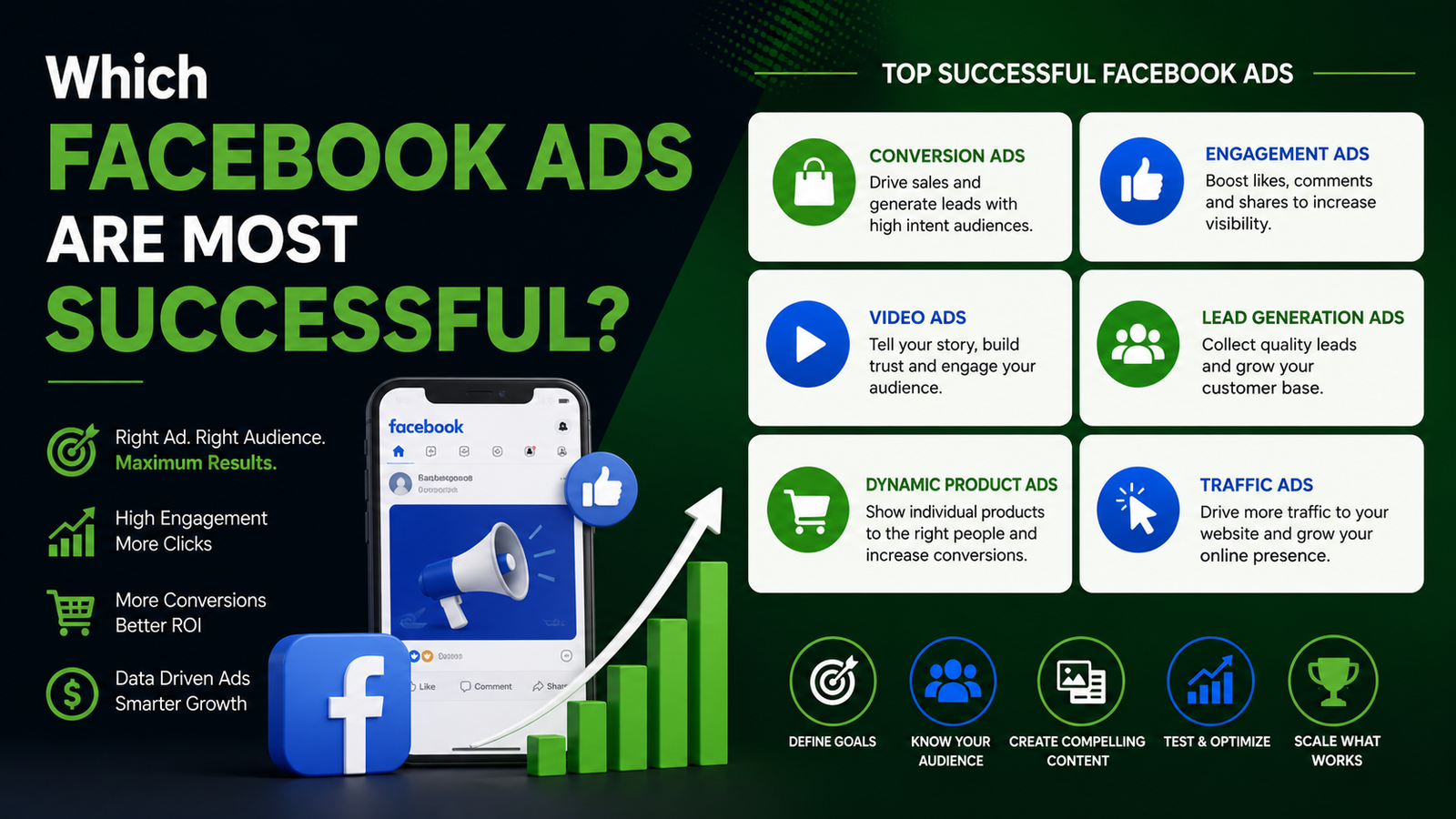
Infographic showing the most successful Facebook ad types, including conversion ads, engagement ads, video ads, lead generation ads, dynamic product ads, and traffic ads with Facebook branding, audience targeting icons, growth chart, and a modern green, blue, black, and white marketing design.

Which Facebook Ads are most successful?

Have you ever scrolled through your social media feed and stopped dead in your tracks because a post felt like it was reading your mind? That usually isn’t a coincidence. Instead, it is the result of a highly optimized digital strategy that knows exactly how to capture your attention. For many business owners, figuring out what actually works on social media can feel like guesswork. The algorithm changes constantly. Because of this, many companies waste thousands of dollars on campaigns that do not generate a single phone call. If you want your business to grow, you cannot rely on guesswork. You need to understand which specific ad formats actively turn casual scrollers into paying customers. For instance, studying a best Facebook ads example from your industry can be very revealing. It shows you the exact visual styles and copywriting formulas that actually work.  At 14K Business Solutions, we analyze market data daily to help businesses maximize their return on investment. Let’s look at what makes Facebook ads perform well today and how you can apply those ideas to your own business and build a highly profitable digital presence. The Anatomy of a Winning Ad Campaign First of all, a successful ad does not look like a traditional commercial. In 2026, the best-performing ads blend naturally into people’s social media feeds. The moment people see something that feels overly polished or overly promotional, they usually keep scrolling.  This is why it’s critical to understand some basic principles of psychology when creating a Facebook ads campaign. The first few seconds matter most. Your ad should immediately grab attention by highlighting a problem your audience relates to or a benefit they care about. Furthermore, your visual content does most of the heavy lifting. Short-form vertical videos and authentic, behind-the-scenes team photos consistently outperform polished stock imagery.  When you analyze a top-tier best Facebook ads example, you will notice a common theme. Specifically, they focus on the transformation of the customer.  They do not just list product features. Rather, they show exactly how the service makes life easier or more enjoyable for the buyer. Driving Growth with Local Targeting For brick-and-mortar companies, broad global targeting is a massive waste of marketing spend. If you operate a physical store or provide a regional service, you must focus your budget on your immediate neighborhood.  Utilizing a specialized local ad service allows you to pin your advertising directly to specific zip codes and geographic areas. Consequently, you only spend money showing your message to people who live close enough to actually buy from you. Moreover, localized messaging creates an instant sense of community trust. People are much more likely to engage with ads that feel relevant to where they live and the services available in their area. Working with an experienced digital marketing team also helps you fine-tune your targeting so your budget reaches the right audience instead of being wasted on people who are unlikely to become customers. Scaling Your Return on Investment Creating a successful Facebook ads campaign involves ongoing experiments. It also requires constant adjustments based on various data. Once your advertisement is released, you shouldn’t just sit back and wait. You will need to observe important metrics on a regular basis. These include click-through rates and cost-per-acquisition. If a visual is not performing well after several days, it is time to swap it out. Replace it with a new one and keep things moving productively. If the thought of dealing with a complex process makes you feel nervous, you are certainly not alone. Many business owners feel the same way in their everyday operations. Many business owners lack sufficient time to monitor stats and tweak bidding rates constantly. As a result, utilizing a professional local ads service will not only free up your time but also speed up lead generation efforts. Professionals will take care of the technical side of your campaigns. This frees you up to concentrate on providing services to your new customers. Dominate Your Digital Market Today Ultimately, social media advertising remains one of the fastest ways to scale a modern business. However, you must approach it with a clear strategy and the right structural framework.  When you build a data-driven Facebook ads campaign, you turn your marketing budget into a reliable client-generation machine. While your competitors continue reaching new customers online, make sure your business isn’t getting left behind. By making use of professional digital marketing, you will have a considerable advantage over your competition in terms of profits.  If you’re ready to stop wondering and start launching successful ad campaigns, contact 14K Business Solutions for a digital marketing audit and discover where your biggest opportunities for growth are. FAQs Is $5 a day enough for Facebook ads? Yes. A $5 daily budget is enough to test different audiences, headlines, or creatives before increasing your investment. Which Facebook ad is best for sales? When it comes to direct sales, video ads and carousel ads are very effective for conversion campaigns. This type of ad allows the advertiser to advertise more than one product or to demonstrate the service offered in action. Best Facebook ad examples? The best Facebook ads example choices always feature clear, high-contrast visuals, a simple benefit-driven headline, and a single call to action. In addition, real customer testimonials, before-and-after results, and user-generated content often perform especially well because they feel more authentic.

Read More »