
Design System

barira

Our Blog

inspiring, insightful & accurate

Lorem ipsum dolor sit amet, consectetur adipiscing elit. Ut elit tellus, luctus nec ullamcorper mattis, pulvinar dapibus leo.

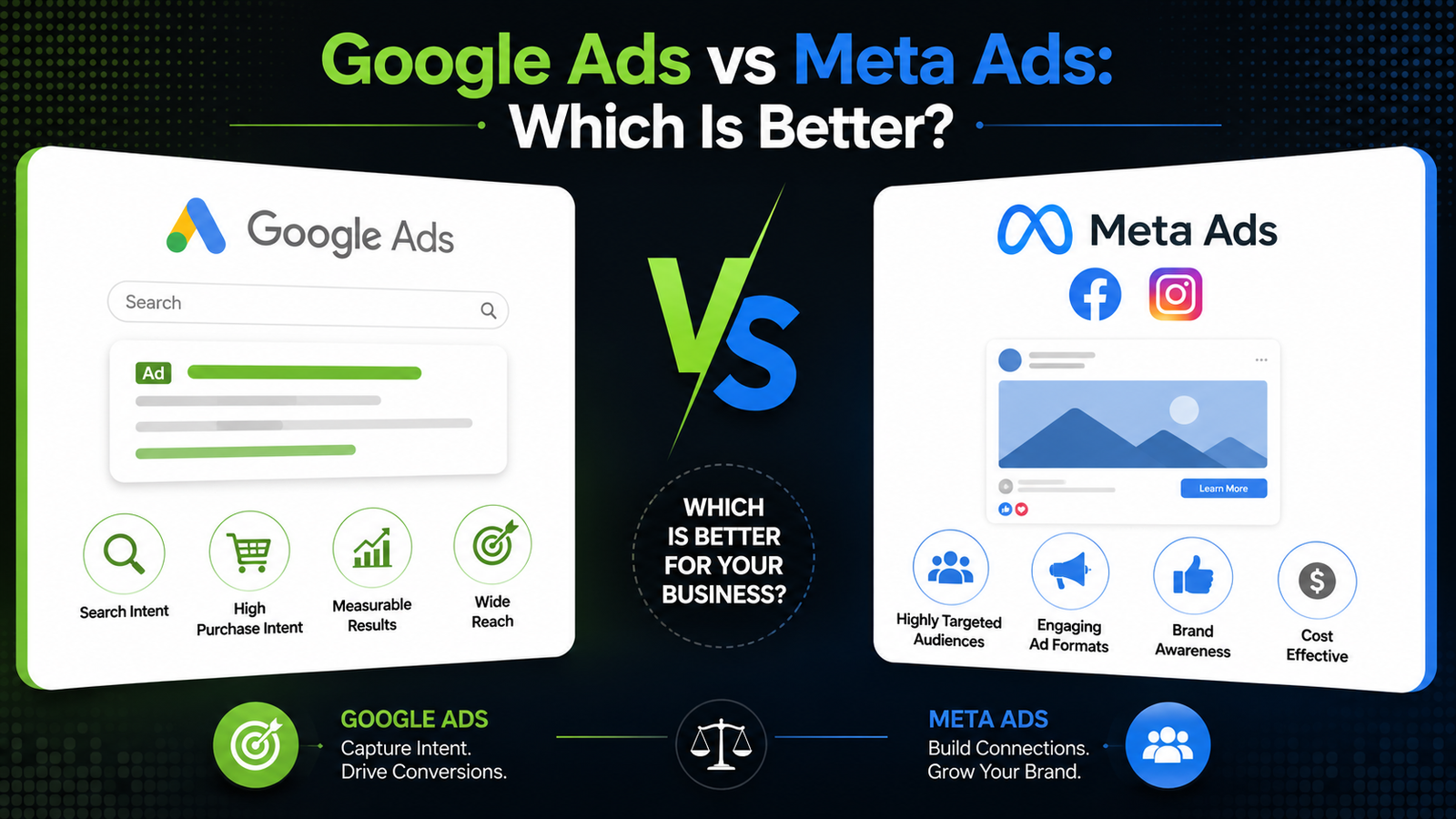
Comparison infographic of Google Ads vs Meta Ads featuring search advertising, Facebook and Instagram advertising, audience targeting, conversion tracking, brand awareness, and ROI metrics with a modern green, blue, black, and white business marketing design.

Google Ads vs Meta Ads: Which Is Better

Most business owners burn through thousands of dollars on the wrong platform before they ever figure out the real difference between Google Ads and Meta Ads. Google Ads helps you reach people who are already searching for a product or service. Meta Ads puts your business in front of people who may not even realize they need what you offer yet. That difference changes everything when it comes to cost, conversions, and where your advertising budget works hardest in 2026. How Google Ads and Meta Ads Actually Work Google local service ads shows your business to people who type searches into Google, YouTube, or partner sites.  When someone types plumber near me or best CRM for small business, your ad pops up right when they signal, they want to buy. This pull model works great for services, emergency repairs, and products people already know they want. Meta Ads works on a push model. The platform studies what users like, where they live, what they buy, and what life events they are going through on Facebook, Instagram, and Messenger.  Then it puts your ad in front of people who look like your ideal customer, even if they are not shopping right now. This approach shines for visual products, lifestyle brands, and anything new that people are not yet searching for. Google Ads relies on keywords and search intent. Meta Ads leans on creative quality and audience matching.  Both can work, but they serve totally different parts of the buying journey. If you understand the difference between Google Ads and Meta ads, you can use these to your benefit.  What Costs and Results Look Like in 2026 According to published 2026 benchmarks, Google Ads search campaigns average $2.96 per click across industries, up from $2.64 in 2025. That marks a 12% year-over-year increase.  Display campaigns on Google run much lower at $0.63 per click. However, industry swings are massive. Legal advertisers pay $6.75 per click on average, while e-commerce sellers pay $1.16. Meta Ads pricing varies sharply by platform. Facebook CPC ranges from $1.06 to $1.72, while Instagram CPC runs $1.83 to $3.35.  E-commerce advertisers on Meta platforms see CPC figures around $0.65 to $0.90. A separate global benchmark puts average Facebook CPC at $0.63. Cheaper clicks sound nice, but they do not always mean cheaper customers. Google Ads search traffic carries strong buying intent because users typed a specific query. Meta traffic arrives through interruption, which means more touchpoints before a sale. Google local service ads matter more than ever for contractors, home service pros, and local businesses who need to show up at the top with verified badges and real reviews. These ads connect service providers directly with local customers who need help right now. The cost and performance of Google Ads and Meta Ads vary from one business to another. Your industry, competition, audience, and campaign goals all play a role in determining which platform delivers the better return.  When to Pick Google Ads vs Meta Ads Your business type and how your customers behave should drive this call, not trends or gut feelings.  Google Ads works best when people already search for what you offer. Locksmiths, dentists, software companies, and lawyers all win by capturing demand that already exists.  If your customers type specific searches into Google, this platform will probably bring faster conversions and stronger leads. Meta Ads works best when you need to build awareness or launch something people are not yet looking for.  Fashion labels, beauty brands, new apps, and lifestyle services often do better on Meta because the platform nails visual storytelling and audience discovery. Someone scrolling Instagram might not need a new face serum today, but the right ad can spark that want. Plenty of smart businesses run both. Meta Ads warm up cold audiences and build familiarity. Google Ads catch those same people later when they search for your brand or service. Running both together typically boosts overall return on investment compared to using just one platform. How Targeting and Creative Strategy Differ Google Ads targeting comes down to keywords, match types, negative keyword lists, and search query quality.  Your ad copy needs to match the exact intent behind the search. Your landing page needs to answer the question fast. The creative challenge here is relevance and clarity, not flashy design. Uniquely, the Meta ads targeting comes down to audience segments, lookalike audiences, and behavioral signals. For Meta ads, your creative assets (creatives) do the heavy lifting. Additionally, short videos, user-generated content, and carousel ads consistently beat static images. But creative fatigue hits fast on Meta, so you need fresh content every few days to keep performance strong. It has been quite obvious that both platforms have leaned harder into automation in 2026. Google Smart Bidding and Performance Max campaigns now handle much of the optimization.  Meta Advantage+ audiences and automated placements have become the default recommendation. This shift means your strategy needs solid conversion tracking, clean data, and strong creative rather than constant manual tweaking. Conclusion When comparing Google Ads and Meta Ads, there is no single winner. Google local service ads grabs high-intent buyers who are actively searching.  Meta Ads creates demand among people who might not know they need your product yet. Your industry, budget, and customer journey should guide where you invest first. For most businesses in 2026, the smartest play is testing both platforms, measuring real cost-per-acquisition, and letting actual data drive your budget split.  Start with the platform that matches how your customers currently behave, then expand into the other as you grow. If you want expert help running Google Ads, Meta Ads, or both together, the team at 14 K Business Solutions builds data-driven campaigns that turn ad spend into real revenue.  Visit 14kbsol.com to see how we can grow your business with paid advertising that actually works.
Read More »
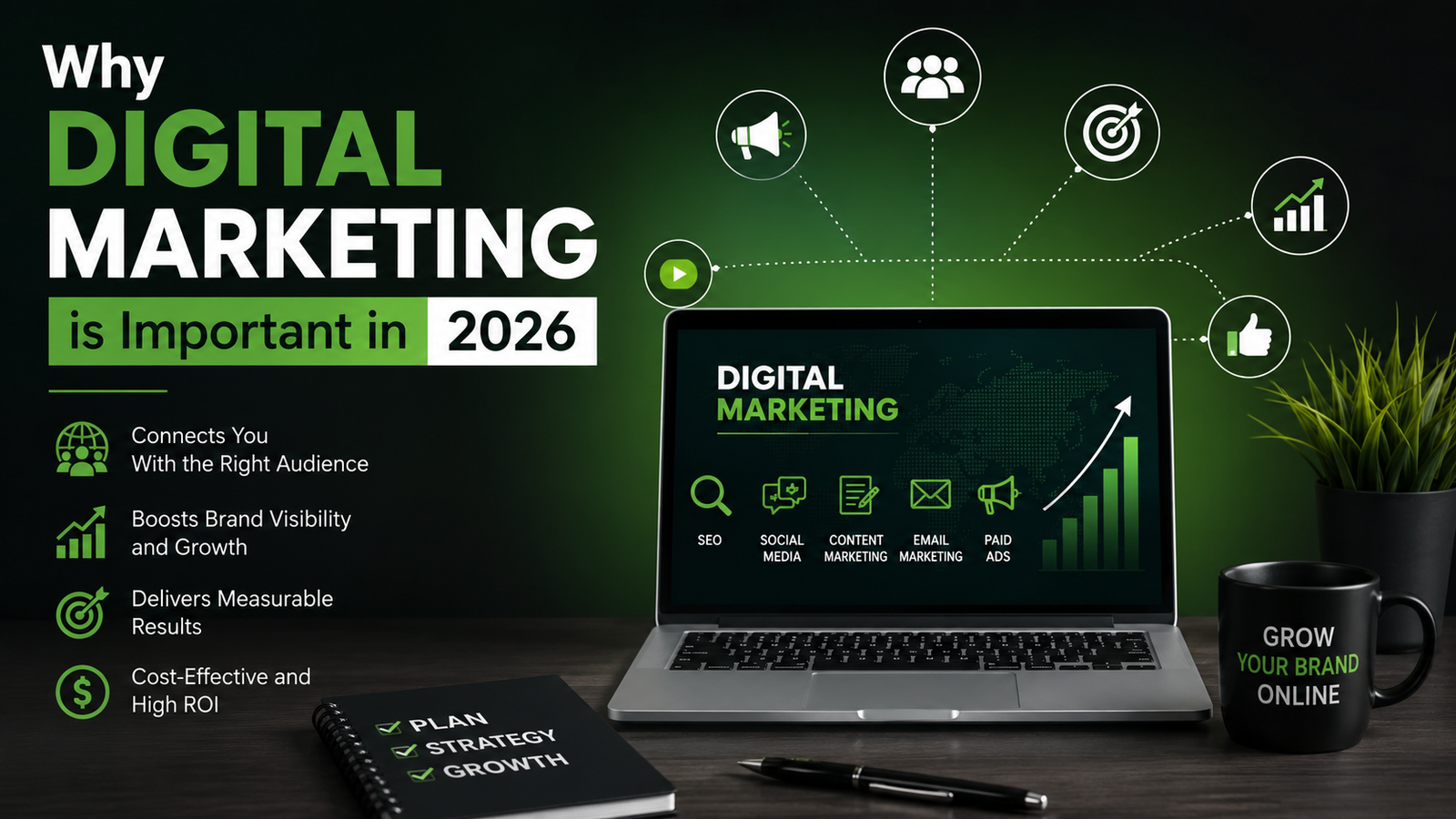
Why Digital Marketing Is Important in 2026 infographic featuring a laptop displaying SEO, social media, content marketing, email marketing, and paid ads with growth chart, marketing icons, and green, black, and white branding representing business growth, online visibility, and digital marketing success.

Why Digital Marketing is Important in 2026

Is your company still utilizing the same marketing strategy employed years ago? If yes, you are likely wasting your budget without realizing it. The digital environment has changed dramatically. In 2026, simple advertising techniques such as ordinary printed flyers or mass emails are no longer effective. Customer behavior has changed. Consumers have become smarter, and their attention spans have reduced significantly. On top of that, AI is revolutionizing how they discover and identify brands in their area. To survive today, your company needs something more than a simple social media account. You need an effective digital strategy that grabs attention at once, generating a substantial profit. Navigating this fast-paced environment requires a cohesive digital marketing strategy. It must adapt to changing algorithms in real time. At 14K Business Solutions, we see firsthand how the right online presence changes everything. Let’s look at exactly why digital marketing is no longer optional for businesses that want to dominate their markets this year. The Evolution of Online Consumer Behavior One of the major changes for 2026 is in the way consumers engage with brands on the web. Customers don’t want to just buy something. They want lightning speed, clarity, and answers. If your web page does not load in two seconds, customers will move on. The same happens if it does not effectively communicate the solution to their problem. Your competitors are just one click away. Creating an effective digital marketing strategy gives you a powerful opportunity. It allows you to reach your target audience in the places they already spend their time. Today, this includes voice search, location-based mobile search, and extremely targeted video ads. In addition, to achieve such a level of optimization, one really needs to have profound expertise. For many small businesses that are still developing, it is hard to justify spending so much time on digital marketing. Managing algorithms, creating short videos, and running ads can quickly become overwhelming. Partnering with an expert digital marketing agency in Philadelphia takes that heavy operational burden off your shoulders. Your local or national campaigns are then managed by specialists. These specialists track changing industry metrics every single day. Overcoming the Modern Competitive Hurdle Every market is more crowded than ever before. However, the solution isn’t simply to spend more money, it’s to spend money more intelligently. Working with an experienced business advisor gives you the structural framework you need. It helps align your digital ad spend directly with your high-level financial goals. They help you analyze cost-per-acquisition metrics so you can scale your operations profitably. 1.      Hyper-Local SEO — Ensuring your company ranks in the top map results when nearby buyers search for your exact services. 2.      Behavioral Retargeting — Sending personalized advertisements to users who have already visited your website. It specifically targets those who have not yet made a purchase. 3.      Data-Driven Conversion — This involves designing your landing pages with easy-to-follow copy and forms. The goal is to turn visitors into customers. By combining strong creative methods with well-organized structuring, marketing transforms completely. It stops being just a costly tool and becomes a steady, measurable way of bringing clients into your business. Scaling with Strategic Partners To maximize your growth, your local search visibility must be flawless. If a customer in your region searches for your service and your name doesn’t appear in the top three map results, you are effectively invisible. Trusting your local audience to a leading digital marketing agency in Philadelphia ensures optimal implementation of your geographic targeting, local keyword optimization, and review collection tactics. In the end, sustainable business success does not stop with sales for the week. Having a reliable business advisor allows you to make sure that your digital presence sets you up for long-term market position and value. They help ensure every dollar you funnel into digital platforms is working hard for you. Each dollar actively builds a sustainable asset for your enterprise. Take Absolute Control of Your Growth When you integrate a data-backed digital marketing strategy and partner with a specialized digital marketing agency in Philadelphia, you gain a powerful edge. Add a knowledgeable business advisor to the mix, and you build an unstoppable competitive advantage. Don’t let the algorithms determine your company’s revenue and future. 14K Business Solutions is here to provide a comprehensive assessment of your digital presence. They will cut your inefficient advertising costs and build a successful digital system for your brand. Contact us now for a strategic growth consultation and get started with emerging victorious in your industry. FAQs: What are the latest trends in online marketing? Current leading trends are driven by several key advancements. These include AI-powered personalization, short interactive videos, and ultra-local visual searching. Clients are no longer satisfied with general information. They are increasingly demanding up-to-the-minute content that is relevant to their specific location or intent. What is the 3-3-3 rule in marketing? The 3-3-3 rule is a contemporary idea for gaining someone’s attention. First, after grabbing someone’s interest in 3 seconds, you must convey your message and establish trust in 3 minutes. Third, you need to touch your audience 3 times with different messages for them to accept your offer and take action. What are the biggest benefits of digital marketing for small businesses in 2026? The single greatest benefit is the level playing field. A small business utilizing a precise, local digital marketing strategy can outrank massive corporations for regional searches. This allows you to capture high-intent local clients without needing a million-dollar corporate advertising budget.

Read More »
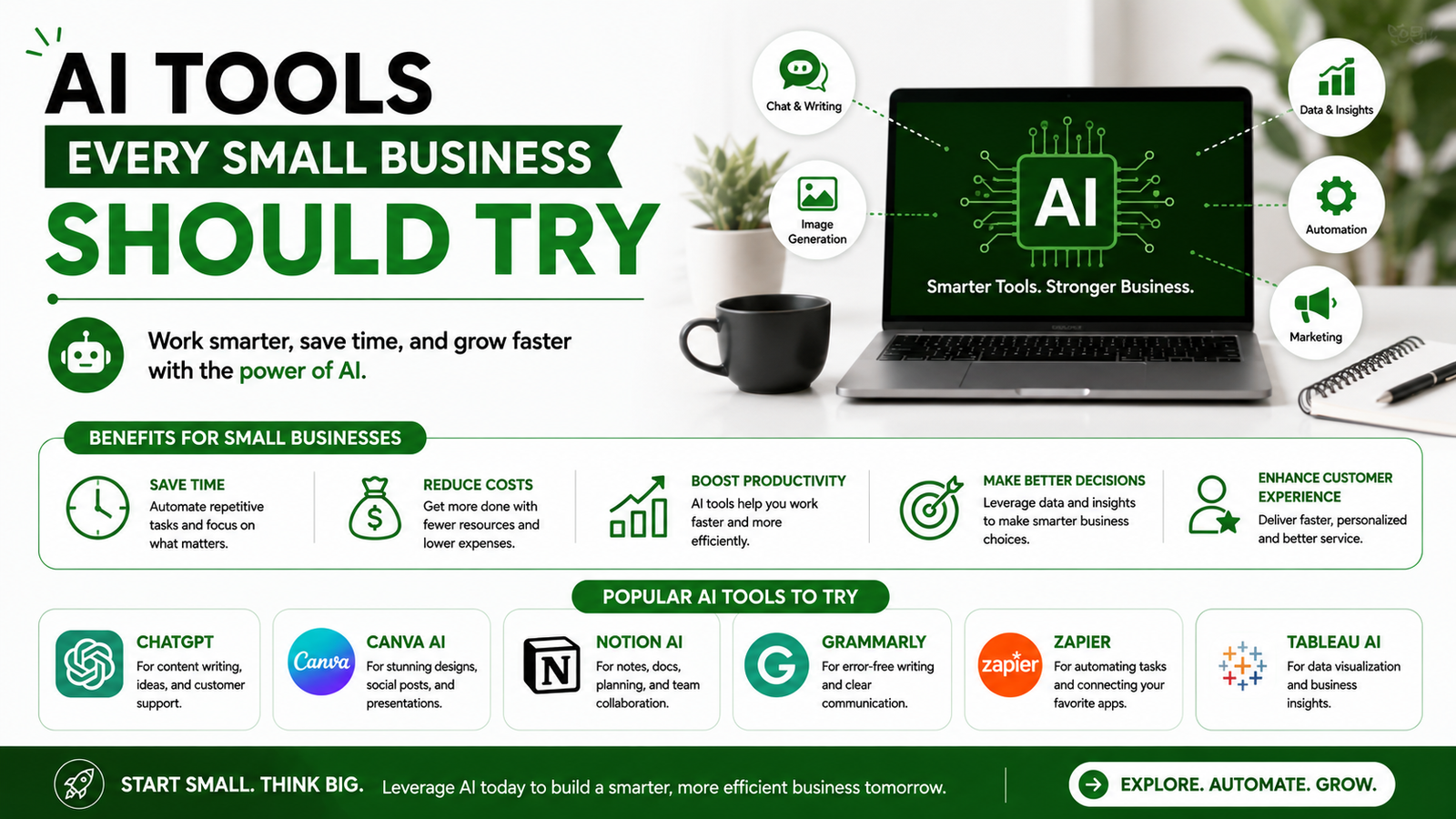
AI tools for small businesses featuring automation, productivity, data insights, and digital solutions with a modern green, white, and black business design.

AI Tools Every Small Business Should Try

Artificial intelligence is helping small businesses automate routine work, improve customer experiences, and operate more efficiently than ever before. In the past, AI was mostly used by large companies with big budgets. Today, it is available to businesses of all sizes. Many small businesses are using AI to save time, improve customer service, create content, and automate everyday tasks. There are many AI tools for small business owners that can make running a company easier. Whether it is helping with marketing, customer support, or organization, AI can help business owners focus more on growing their business instead of spending hours on repetitive work. Best AI Tools for Small Business One of the most popular business automation tools is ChatGPT. It can help write social media posts, emails, blog articles, and product descriptions in just a few minutes. Instead of staring at a blank screen trying to come up with ideas, business owners can use AI to create a starting point and save valuable time. Another useful tool is Canva AI. Many small businesses do not have the budget to hire a graphic designer, so Canva AI helps create professional-looking social media posts, flyers, and advertisements. It is simple to use and can make a business look more professional online. For customer service, tools like Zendesk AI and Tidio can answer common customer questions automatically. If a customer wants to know store hours, shipping information, or return policies, AI chatbots can respond instantly, even outside of business hours. Businesses that conduct frequent meetings can also benefit from tools like Otter.ai and Fireflies.ai. These AI-powered meeting assistants automatically record conversations, generate transcripts, summarize key discussion points, and create action items. This helps teams stay organized and reduces the need for manual note-taking. When it comes to organization and productivity, Notion AI is one of the best AI productivity tools for business. It helps keep track of projects, create notes, and organize important information. Microsoft Copilot is another helpful option because it works with Word, Excel, and Outlook to make everyday tasks faster. For research and information gathering, Perplexity AI has become a popular choice. It helps business owners quickly find answers, summarize complex topics, and gather insights from multiple sources, making research faster and more efficient. Businesses looking to automate tasks should consider Zapier. It is one of the most popular small business automation tools because it connects different apps and automates workflows. For example, when a customer places an online order, Zapier can automatically send a confirmation email and update customer records without anyone having to do it manually. Email marketing is another area where AI can save time. Platforms like Mailchimp AI and Brevo AI help businesses create email campaigns, generate content suggestions, segment audiences, and optimize send times. These features help improve engagement while reducing the amount of manual work required.  HubSpot AI is another useful option for businesses looking to improve marketing, customer relationship management, and lead nurturing efforts. Finally, QuickBooks AI is a great example of AI software for small businesses. It helps track expenses, organize financial records, and monitor cash flow, making it easier for owners to understand how their business is performing. How a Small Business Can Use AI Imagine a small clothing store called Urban Threads. The owner does not have a large staff and handles most of the business alone. Using ChatGPT, the owner creates social media posts promoting a summer sale. Canva AI designs graphics for Instagram and Facebook. Zapier automates order confirmations and customer emails. Zendesk AI answers customer questions on the website, while QuickBooks AI keeps track of sales and expenses. Instead of spending hours completing these tasks manually, the owner can focus on customers and growing the business. This is why many entrepreneurs consider these tools some of the best AI tools for business available today. Benefits and Limitations of AI The biggest benefit of AI is that it saves time. Small business owners can automate repetitive tasks, create content faster, and improve customer service without hiring additional employees. AI can also help reduce costs and increase productivity. However, AI does have limitations. It is not always accurate, and businesses should review AI-generated content before publishing it. AI also cannot replace human creativity, personal relationships, or important business decisions. It works best as a tool that supports people rather than replaces them. Conclusion AI is changing the way businesses operate, and it is becoming an important resource for entrepreneurs. There are many AI tools for small business owners that can help with marketing, customer service, organization, and automation. The best AI tools for business allow companies to work more efficiently, save money, and focus on growth. While AI is not perfect, it can be a valuable tool when used correctly. As technology continues to improve, more businesses will likely adopt AI software for small businesses to stay competitive and meet customer expectations. FAQs Which AI tool is best for small business? The answer depends on the business. ChatGPT is great for content creation, Canva AI helps with design, Zapier is useful for automation, QuickBooks AI assists with financial management, and HubSpot AI supports marketing and CRM activities. Many businesses use a combination of tools rather than relying on just one. What can small businesses use AI for? Small businesses can use AI for marketing, social media content, customer service, bookkeeping, scheduling, workflow automation, and data analysis. AI helps save time and improve efficiency. What is the 30% rule for AI? The 30% rule is the idea that AI should assist with part of a task while humans handle the rest. AI can help generate ideas, create drafts, or automate simple work, but people should still review and make final decisions.

Read More »
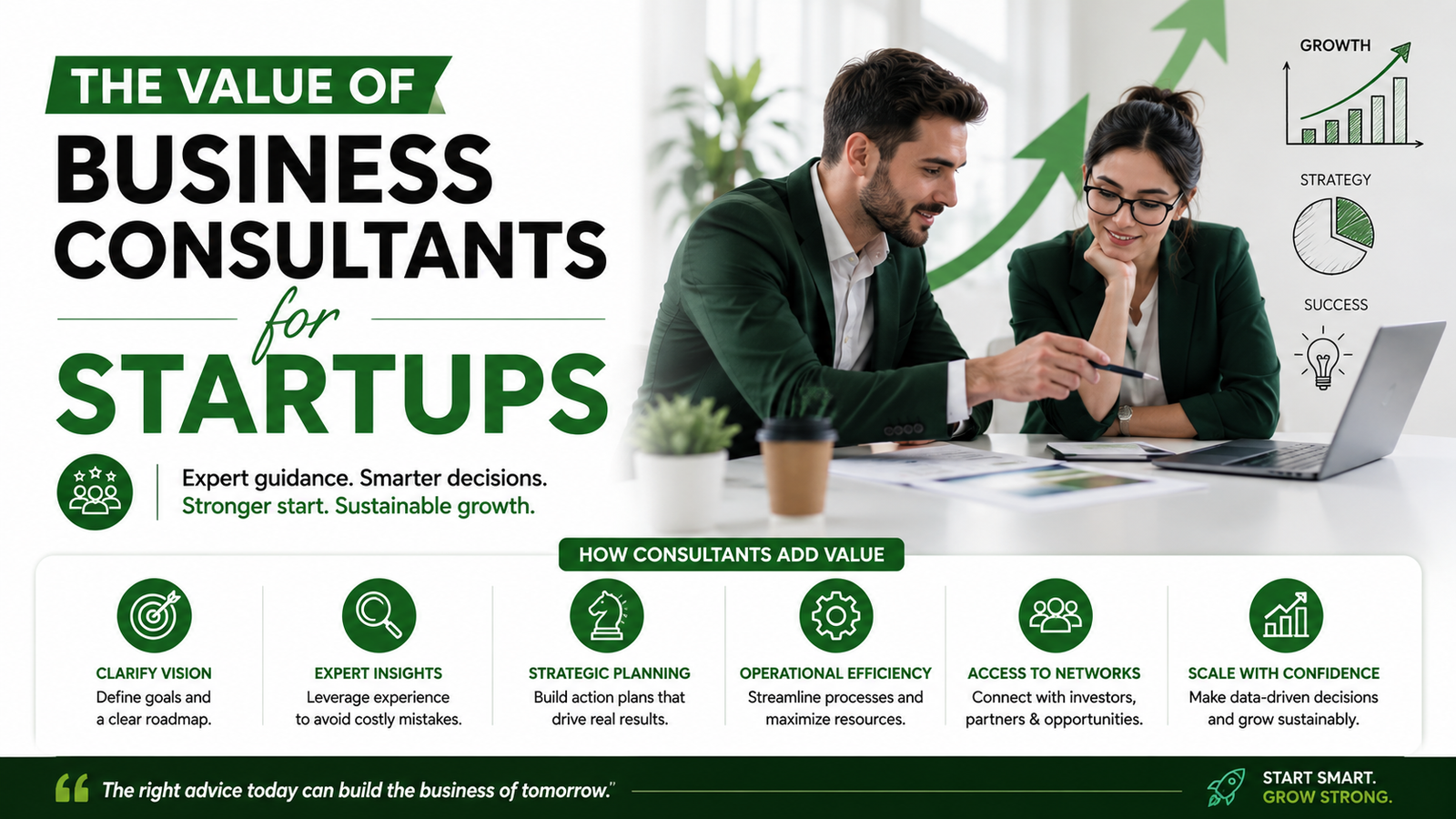
Business consultants helping startups grow with strategic planning, expert guidance, and professional advice shown in a modern green and white corporate setting.

The Value of Business Consultants for Startups

Nine out of ten startups eventually fail, yet thousands of founders ignore that warning every single year.  Globally, more than 50 million new startups launch every year, and most never reach their fifth anniversary. That single statistic explains why business consultants for startups have become essential, not optional.  This guide breaks down the real data behind startup failure and how startup business consulting actually changes the odds. Why So Many Startups Struggle Without Outside Guidance The 90 percent failure statistic gets repeated constantly, but it needs context. That number applies mainly to high-growth, innovative startups, according to Startup Genome.  For all new businesses, federal data tells a slightly different story. According to the Bureau of Labor Statistics (BLS) , 20 percent of new businesses fail within the first year. That number climbs to 49.4 percent by year five, and 65.3 percent by year ten. Either way, the underlying causes stay remarkably consistent. Usually, 42 percent of startups fail simply because no one wants the product. Running out of cash follows close behind at 29 percent. Together, these two causes explain 71 percent of every startup shutdown.  Meanwhile, poor cash flow management alone drives 82 percent of small business failures. So, the pattern is clear: founders rarely fail from a lack of effort. They fail from a lack of validated demand, financial discipline, or both.  Industry also shapes these numbers significantly. Tech startups face a 63 percent failure rate within five years. Healthcare-focused businesses fare much better, with 60 percent surviving past year one. That gap shows why generic advice rarely works across every sector. What Business Consultants for Startups Actually Do A good business consultant for startups attacks exactly those two weak points early. Startup business consulting services typically start with market validation, not branding or design. This means testing real demand before a founder spends months building the wrong product.  From there, consultants typically build a financial model that tracks runway, burn rate, and break-even targets. On top of strategy, many consultants bring direct access to investor and partner networks. Research from Harvard Business Review shows accelerator programs alone reduce failure rates by 10 to 15 percent.  Business consultants for startups offer that same structured mentorship, often tailored to a single founder’s exact situation. Usually, when a startup business consulting work alongside early-stage founders, the biggest value often comes from an outside perspective.  Naturally, founders get too close to their own idea to see its obvious blind spots. A consultant asks the uncomfortable questions a friend or co-founder usually avoids. A consultant essentially lends years of pattern recognition to someone building their very first company. This mentorship cannot fully replace real experience, but it shortens the learning curve dramatically. ROI of Startup Strategy Consulting Services Skeptics often ask whether startup strategy consulting services‘ consulting fees are actually worth the investment. The data leans heavily toward yes.  According to Consulting Success, companies see a median return of 7 times their initial coaching investment. Organizations using structured coaching also report a 70 percent improvement in performance and productivity. Notably, 96 percent of clients who hire a coach or consultant say they would repeat the process. Funding strategy matters here, too. Bootstrapped startups post a 58 percent five-year survival rate, compared to 32 percent for venture-backed companies. Good small business growth consulting helps founders build that same disciplined, cash-conscious mindset early. Choosing the Right Small Business Growth Consulting Partner Not every consultant fits every founder or every industry. Look for proven case studies, not just an impressive sounding pitch deck. Ask specifically about their experience inside your exact growth stage and sector.  Transparent pricing also matters, especially for founders managing a tight early-stage budget. Reading client reviews and testimonials offers another honest signal before signing any contract. Communication style counts just as much as technical skill. A great business consultant for startups explains complex strategy in plain, actionable language. That clarity, more than any framework, often separates good consultants from great ones. Final Thoughts Startup failure rates remain high, but they are not random. Most failures trace back to weak validation, poor cash management, or both. The right business consultants for startups attack both problems from day one. That structured guidance, backed by real data, consistently shifts the odds in a founder’s favor. For founders ready to build on a stronger foundation, 14KB Solutions offers experienced startup business consulting services. Frequently Asked Questions Why do 90% of small businesses fail? That 90 percent figure specifically describes high growth, innovative startups tracked by Startup Genome. For typical small businesses, federal data shows a lower, though still serious, failure rate. About 20 percent fail in year one, and 49 percent fail by year five. The two biggest causes stay consistent across both groups: weak demand and poor cash flow. Is AI going to replace consultants? Not anytime soon, based on current evidence. AI handles research, data analysis, and slide creation faster than most junior staff. However, it still struggles with framing the right problem in the first place. Client trust, negotiation, and change management also remain deeply human skills. In fact, 95 percent of generative AI pilot projects fail to deliver measurable ROI, according to recent research. That gap is exactly where experienced human consultants continue adding real value. Can a business consultant help me start a business? Yes, especially during the earliest and riskiest planning stages. A consultant can validate your idea before you spend a single dollar building it. They also help structure your financial model, pricing, and early go-to-market plan. From my experience, founders who get this groundwork right move faster once they actually launch. A second opinion at the planning stage often prevents the most expensive mistakes later.

Read More »
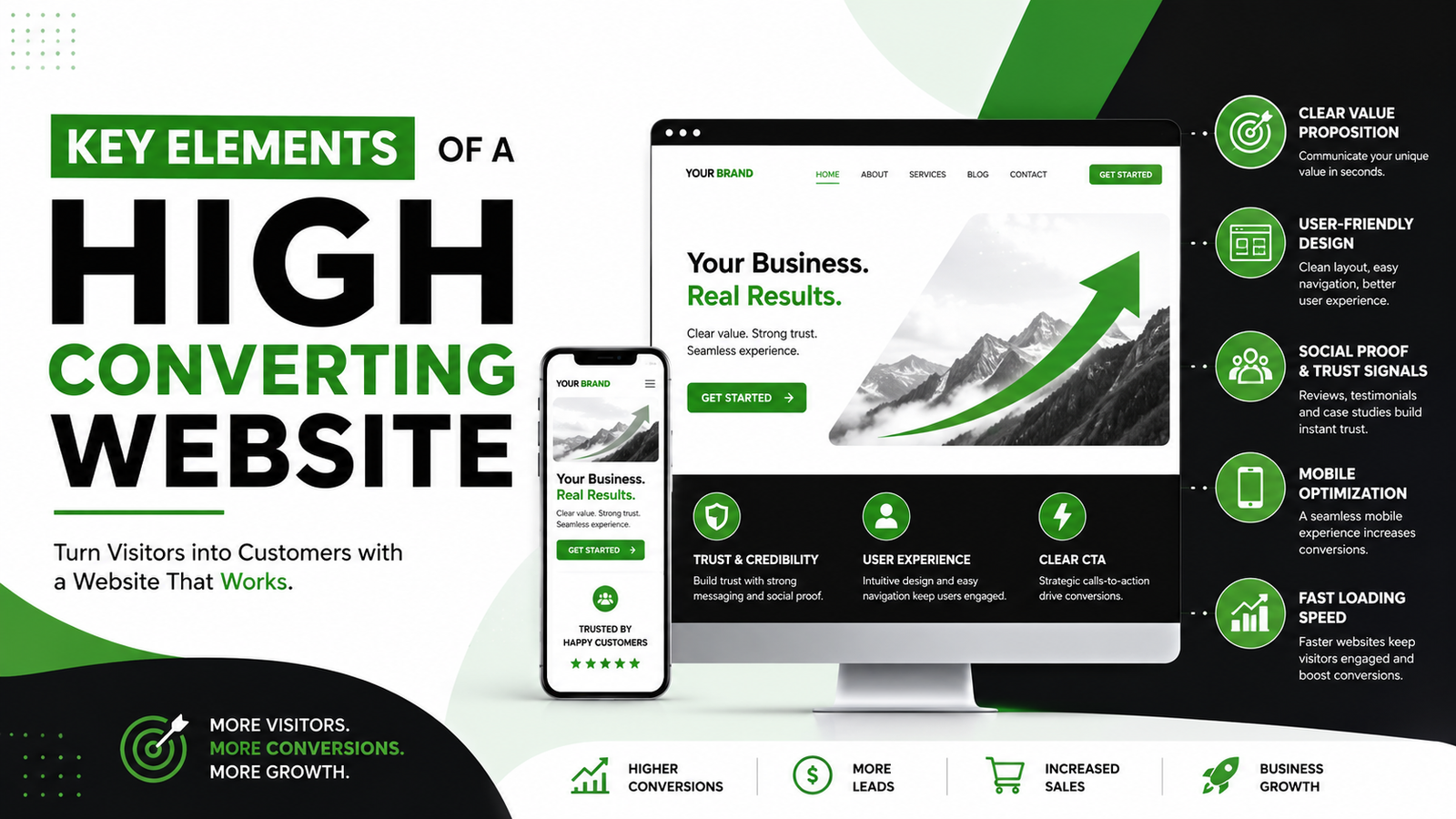
Key elements of a high converting website shown through a modern web design layout with desktop and mobile screens, highlighting user experience, clear calls to action, trust signals, fast loading speed, and conversion growth in a green, black, and white theme.

Key Elements of a High Converting Website

Most businesses today already have a website, but not all of them get results from it. Some sites just sit there and look fine, yet they don’t bring in customers or enquiries. Others quietly turn visitors into real leads every day. The difference usually comes down to how the website is planned and how it feels to use. A high converting website is not only about design. It is more about how easily a visitor understands the business and how naturally they move toward taking action. That action could be sending a message, booking a service, or making a purchase. When everything feels simple, people are more likely to respond. First Impression Sets the Mood When someone lands on a website, they don’t spend much time thinking. They quickly decide if they trust it or not. Sometimes it takes only a few seconds. If the message is confusing or too busy, people leave. If it feels clear and direct, they stay longer. That’s why the homepage needs to speak in a simple way. No heavy language. No guessing games. Just a clear idea of what the business does. This is where website conversion optimization quietly starts working. When visitors understand the offer right away, they don’t feel lost, and that small comfort matters a lot. Keeping Things Easy to Move Around One of the biggest reasons websites fail is simple confusion. People cannot find what they are looking for, so they leave. Menus should feel natural. Pages should not be buried. Contact details should never be hard to locate. A visitor should not feel like they are solving a puzzle just to learn about a service. Good structure is a big part of website user experience optimization. When everything flows smoothly, people naturally explore more. And the longer they stay, the better the chances they will take action. Design That Actually Guides People A lot of websites focus only on looking modern. But design alone does not bring customers. What matters more is whether the design guides people toward a decision. Buttons should feel easy to notice. Important messages should not be hidden. The layout should gently push visitors in the right direction without feeling forced. That is the idea behind conversion focused web design. It is not about decoration. It is about removing confusion and helping people know what to do next without overthinking. Content That Feels Real and Helpful People usually come to a website because they have a question in mind. They want clarity before they trust a business. If the content feels too sales-heavy, they often lose interest. But when the language is simple and honest, it feels more believable. Visitors don’t need big words. They need answers. This kind of approach naturally improves website conversion optimization because people stay longer when they feel understood instead of sold to. Speed Still Matters More Than People Think A slow website can ruin interest very quickly. Even if someone is curious, waiting for pages to load can push them away. Fast websites feel more reliable. They also feel easier to use. People don’t think about it consciously, but speed affects trust. This is a core part of website user experience optimization. When things respond quickly, users stay engaged without frustration. Trust Is Built in Small Pieces Nobody gives their details to a website they don’t trust. That trust is built slowly through small signals. Reviews help. Real feedback helps even more. Even simple things like visible contact details or clear service explanations can make a difference. A strong lead generation website design always keeps this in mind. It doesn’t try to force trust. It builds it step by step while the visitor scrolls. Making It Easy for People to Reach Out Sometimes visitors are interested but still don’t take action. The reason is often simple. The next step is not clear enough. Forms should be short. Buttons should be obvious. Contact options should not feel hidden or complicated. When lead generation website design is done properly, reaching out feels like a natural step instead of a decision. That is when leads start increasing without needing more traffic. Mobile Experience Matters More Than Ever More people browse websites from their phones than from desktop computers. If a website feels difficult to use on a small screen, visitors often leave without giving it a second chance. Buttons should be easy to tap, text should be easy to read, and pages should load smoothly without forcing users to zoom in or scroll sideways. Mobile usability plays a major role in both website user experience optimization and website conversion optimization. When people can quickly find what they need on any device, they are far more likely to stay engaged and take action. FAQs What makes a high converting website? A high converting website is clear, fast, and trustworthy. It tells visitors exactly what to do next, removes any friction in the way, and gives them a reason to believe you before they commit. What are the 7 principles of conversion? The seven principles are clarity, trust, relevance, value, simplicity, urgency, and action. When these are present, people find it easier to make decisions. What are the five golden rules of a website? Be clear, load fast, design for mobile, focus each page on one goal, and make it easy to trust you. Simple as that, most failing websites are breaking at least two of these. Final Thoughts At the end of the day, a website should do more than just exist online. It should help a business connect with real people and turn interest into action. When businesses focus on conversion focused web design, improve website user experience optimization, and use smart lead generation website design, results usually improve without needing anything complicated. If you want a website that feels simple, clear, and built to bring in real customers instead of just traffic, 14K Business Solutions can help you get there.

Read More »
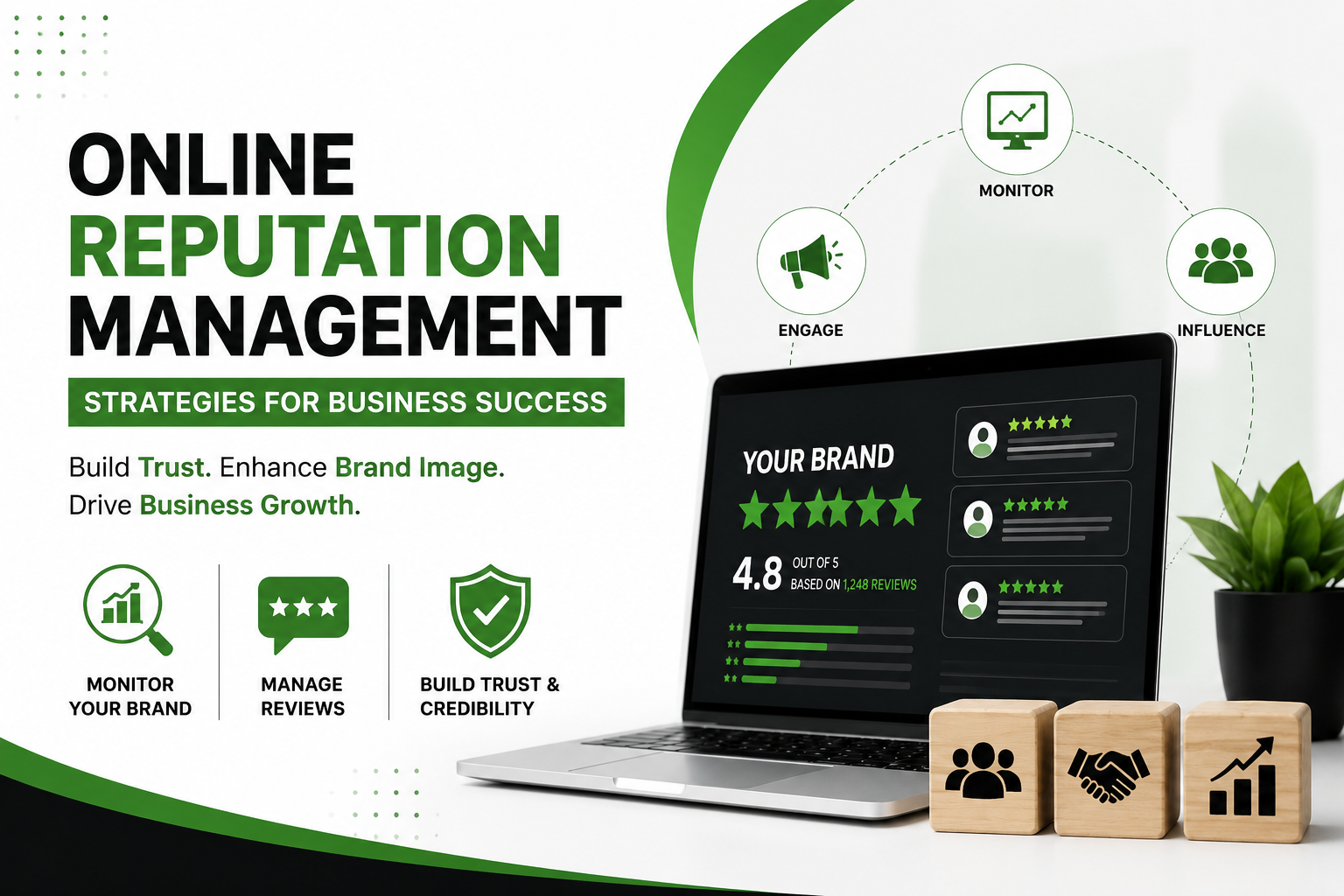
Online reputation management strategies infographic showing brand trust, customer reviews, reputation monitoring, and business growth on a laptop with green, white, and black design.

Online Reputation Management Strategies for Business Success

Would you buy from a business that has a messy two-star rating online? Probably not. In 2026, your digital footprint is essentially your front door. Before customers ever call you or look at your products, they check what strangers say about you on the internet.  If they find bad reviews or zero information, they will just skip you and click on a competitor instead. Managing your digital image is no longer a luxury. It is a core requirement for survival.  To protect your revenue, you need proactive online reputation management tactics that actively build consumer trust.  The internet never sleeps, and gossip spreads incredibly fast. A single angry post can spiral out of control before you even finish your morning coffee. At 14K Business Solutions, we see companies build amazing services. But their growth often stalls because of a bad digital footprint. It does not matter how good your product is if the internet says otherwise. If you want to protect your hard work, you have to look into the best online reputation management services to keep your name clean.  Let’s dive into how you can control your digital narrative and turn customer feedback into your biggest sales tool.  The Reality of Modern Customer Trust Consumer behavior has shifted wildly over the last few years. People do not just trust slick commercials or clever taglines anymore. They trust the raw experiences of other real buyers.  This is why proactive brand reputation management is so vital for businesses of every single size. You need to actively monitor what is being said about your business across every platform from Google to social media.  When you ignore your digital presence, you let other people write your story. A solid strategy involves listening to your audience, asking for feedback, and highlighting your wins. This is how you shift from being passive to actively running a great business reputation management campaign. If you are not actively steering the ship, the internet will do it for you. Why Reviews Make or Break Your Sales Let’s talk about reviews. Reviews often play a major role in whether someone chooses your business or keeps searching. A systematic approach to online review management ensures that your happiest customers are actually speaking up.  Most satisfied buyers do not think to leave a review unless you ask them to. On the flip side, unhappy customers are highly motivated to vent online. If you do not have a tool or a team to encourage good feedback, your online presence may end up reflecting more negative experiences than positive ones. You need a system that makes leaving a review completely seamless for your clients.  By sending automated text or email follow-ups right after a purchase, you can dramatically boost your positive scores. Handling the Heat Professionally No business is completely perfect. You are going to get a bad review eventually. The trick is not to panic or get defensive when it happens. A bad review is actually a massive opportunity to demonstrate your customer service.  When you reply to an angry customer with kindness and a real solution, you aren’t just talking to them. You are talking to every single person who reads that review in the future.  People respect honesty. They want to see how you handle problems when things go wrong. A bad situation handled well can actually win you more trust than a perfect five-star wall ever could.  Building Your Long-Term Defense Plan At 14K Business Solutions, we believe that a great reputation is your best shield against market changes. We help businesses build automated systems that gather good reviews and track brand mentions. These systems also handle customer complaints quickly. You do not want to wait until a crisis hits to start thinking about your image. By then, the damage is already done, and it takes twice as much work to fix it. True growth happens when you pair great digital marketing with a clean, bulletproof online presence. If your current online score does not reflect how hard you work, it is time to upgrade your plan. You deserve a digital image that actually works for you, not against you.  Let’s look into the best online reputation management services for your specific goals so you can win more customers with ease. Are you ready to clean up your digital presence and dominate your market? Contact 14K Business Solutions today to get a custom brand audit and start building a name that people trust. FAQ: Navigating Digital Real Estate Why Is Online Reputation Management Important for Businesses in 2026? Reviews and online reputation play an increasingly important role in how customers evaluate businesses and how local businesses appear in search results.  If your business has a bad reputation score, AI shopping assistants and maps will literally filter you out of the results entirely. Good online reputation management makes sure you stay visible and trusted.  Can Negative Reviews Hurt Your Google Rankings? Yes, they absolutely can. Google uses review signals like volume, speed, and keywords to rank local businesses. Bad scores can drag your website down the search results page.  If you want to stay on top, you need to look for the best online reputation management services to help balance the scales.  What Is the Fastest Way to Improve Your Online Reputation? The absolute fastest way is to directly ask your best existing clients for honest reviews right now. At the same time, you need to respond to every single negative comment publicly and professionally.  Taking accountability and offering quick fixes shows future buyers that you actually care.

Read More »
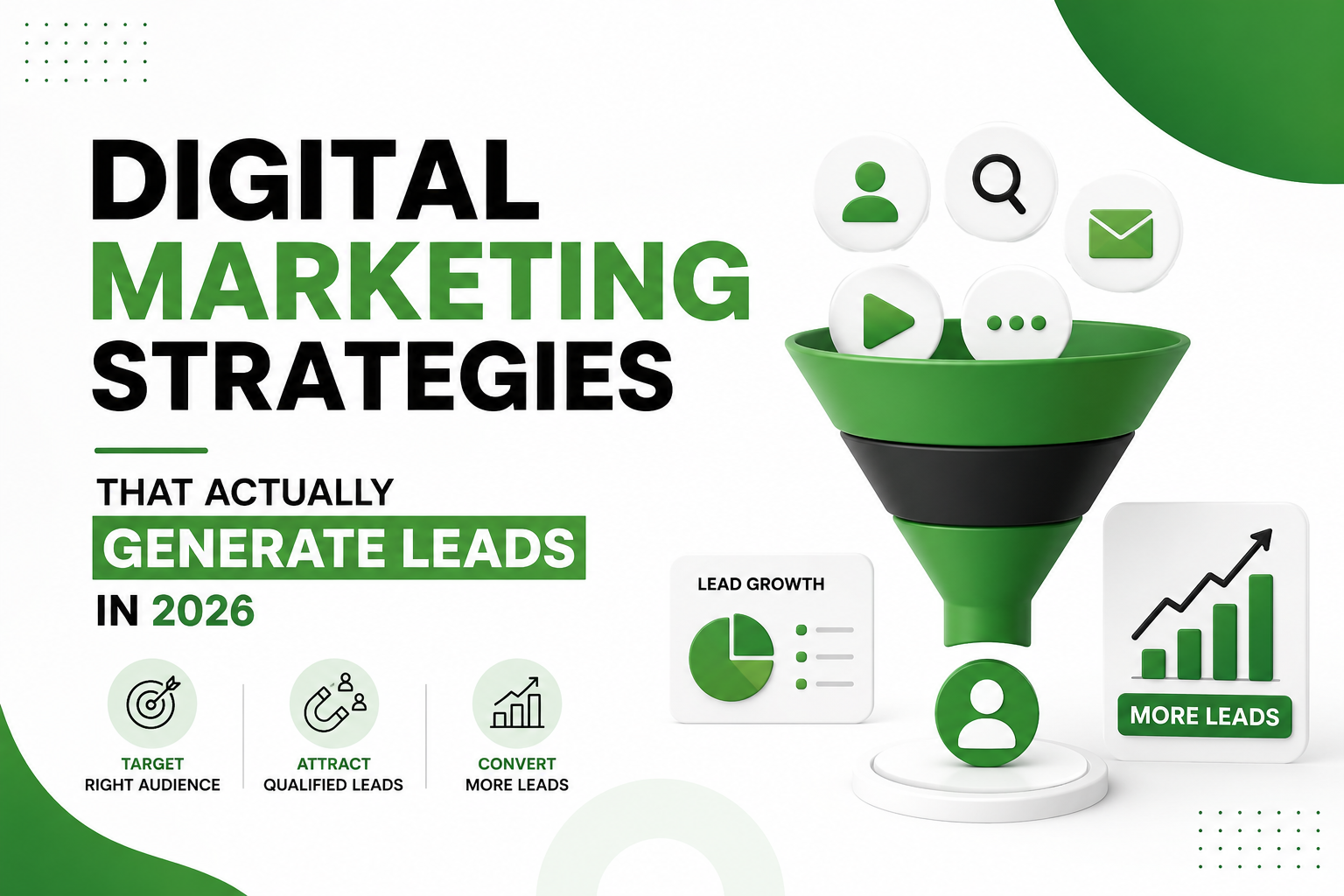
Digital marketing strategies blog banner featuring a green and black lead generation funnel, marketing icons, growth charts, and the headline “Digital Marketing Strategies That Actually Generate Leads in 2026” on a clean white background.

Digital Marketing Strategies That Actually Generate Leads in 2026

Are you tired of throwing money at marketing campaigns that look great on paper but do absolutely nothing for your sales?  It is 2026, and the internet is noisier than ever. Vanity metrics like likes and shares just don’t cut it anymore. Business owners today don’t want clicks.  They want genuine, qualified prospects who actually want to buy. If you want to grow this year, you need to pivot toward digital marketing strategies that focus on conversion. Finding new customers looks very different today. Instead of casting a wide net and hoping for the best, businesses need a more focused approach built around data, technology, and understanding exactly who they want to reach.  At 14K Business Solutions, we witness businesses daily that are challenged to discover a dependable pathway towards expanding their organizations. It doesn’t matter if you are a brand-new startup or an established enterprise. The goal is always the same. You need efficient, high-quality lead generation. If your current approach feels stuck in the past, it is time for a change.  Let’s look at what is actually working right now to fill your pipeline. The New Way to Capture Prospects The most effective digital marketing strategies today are the ones that offer real value right away. Consumers are smart. They know when they are being marketed to and they hate generic ads. To win their trust, you have to help them before you ever ask for their money. Modern lead generation is all about making things easy for your potential customer. You need to optimize your landing pages for exactly what people are searching for. You should use personalized email sequences.  Every single interaction a prospect has with your brand needs to be backed by clean data. If your online marketing strategies are not working, it is usually because they are too generic. Why AI Changes Everything You cannot talk about business growth today without mentioning AI digital marketing. AI is not a futuristic concept anymore.It is the core engine behind the most successful campaigns out there. By using machine learning to predict user behavior, we can serve the right content at the exact moment a prospect is ready to act. For example, AI digital marketing tools can look at thousands of data points to optimize your ad spend on the fly.This keeps you from wasting cash on clicks that go nowhere. It helps you write better copy and group your audience perfectly. It even automates follow-ups so you never lose track of a prospect. If you are not using these tools, you are falling behind your competitors. What Works for B2B Lead Generation? If your business focuses on B2B lead generation, the game is all about building trust over time. Decision-makers do not buy things because of a single social media ad. They want to see case studies and clear proof that your services work. Your online marketing strategies have to prioritize relationship building. This is where automated workflows and content marketing become your best friends. By sharing valuable insights through newsletters, you prove you know your stuff before a salesperson ever calls. When that call finally happens, the lead is already warm. They know who you are and they understand your value. Building Your Growth Plan At 14K Business Solutions, we believe the best results happen when you mix creativity with hard data. We do not believe in setting up a campaign and walking away. We constantly check the numbers and tweak things to get better results. When you align your business goals with the right digital plan, you can actually measure the success. You get a lower cost per lead and higher quality prospects. The tools we have this year are incredibly powerful, but they only work if you have a solid plan guiding them. You do not need to chase every single new internet trend. You just need to execute the core strategies that bring in revenue. If your current marketing feels like a black hole for your budget, it is time to pivot.  Growth should not be a guessing game. It should be a predictable result of smart decisions. Are you ready to stop guessing and start scaling? Contact 14K Business Solutions today to get a custom performance audit and see where your biggest opportunities are hiding. FAQs: Which Digital Marketing Strategy Generates the Most Leads in 2026? There is no single magic trick. The most successful businesses use a mix of tactics. They combine high-intent search traffic with great educational content.  This catches people when they are actively looking and when they are just researching. The best digital marketing strategies nurture these prospects until they are ready to buy. Is SEO Still Better Than Paid Ads for Lead Generation? You need both. It is all about timing. SEO is your long-term play to build organic authority and lower costs over time. A good B2B lead generation plan uses SEO for steady growth and PPC for quick wins today. How Is AI Changing Digital Marketing in 2026? AI helps businesses make smarter marketing decisions using real-time data. Instead of relying on assumptions, businesses can better understand customer behavior, personalize campaigns, and improve lead generation efforts.

Read More »
Modern custom logo and web design blog banner with green, white, and black branding elements, responsive website mockup, and business identity visuals.

Creating a Competitive Edge with Custom Logo and Web Design

Your online identity dictates your business success because consumers judge your credibility within less than a single second.  We all know human attention has reduced to the chimpanzee’s attention span. Similarly, the tolerance for the design of the website (user experience), load time, and other segments pushes them to competitors within seconds.  A generic digital presence will instantly push potential buyers directly toward your closest competitors. Therefore, you must establish a distinct market position to survive. Investing in a custom logo and web design gives your company a major competitive edge. You build immediate trust when your branding matches your actual business values. This strategy transforms random website visitors into loyal long-term clients. Building the Identity from Scratch  Many brands try to save money by purchasing cheap online design templates. However, thousands of other websites use those identical layouts every single day. Your brand will easily get lost in a massive sea of ‘corporate sameness.’ On the other hand, a true professional web design service builds your online platform completely from scratch.  It all begins with the color palettes and layout architecture with your target user’s psychology. All the thoughtful work and calculated approach help businesses achieve far better conversion rates over time. Furthermore, your logo acts as the primary anchor for your entire customer experience. A unique visual identity ensures that people remember your company name after buying. This visual memory stimulates organic word-of-mouth marketing for your brand. Generic Template is Bad News  Pre-made website templates look incredibly simple and fast to deploy at first. Also, you are converted instantly by words like “no developer needed, no web development experience needed.” These custom templates contain bloated background code that severely hurts your loading speeds (LCP). Google doesn’t like to spend time and budget on slow websites. As a result, a slow and bloated website becomes the anchor that pulls you down.  A custom website design for businesses eliminates unnecessary elements to optimize loading performance. Conversely, faster websites naturally keep users engaged for longer periods of time.  The functional efficiency (let’s call it the Vin Diesel effect) gives you a massive advantage over standard marketplace templates. In addition, templates heavily restrict your long-term creative freedom and growth. You cannot easily add advanced features as your business operations expand.  Custom development with the Vin Diesel effect lets you scale your system without encountering technical limitations. Measurable Performance and Data Recent industry research proves that modern design directly impacts your total revenue. For example, companies with strong design outperformed their competitors by nearly two to one.  This data demonstrates that great visuals act as a major business driver. Moreover, mobile devices generate more than half of all global web traffic today. Fixed templates rarely adapt perfectly to every different smart device screen size.  Custom responsive layouts ensure a smooth experience for absolutely every visitor. Excellent user experiences cause consumers to view a company much more favorably.  On the flip side, a poor layout structure causes people to leave immediately. You directly save ad spend by keeping traffic on your platform longer. Integrating Branding with Web Development Your physical product and your digital portals must tell the same story. Combining your branding and web design services creates a very unified corporate narrative. Consistency across platforms makes your company look highly reliable and thoroughly established. For instance, your digital logo must retain perfect clarity on a mobile screen. It must also look incredibly sharp on large physical billboards or corporate merchandise. Specialized logo design services optimize your graphics for every single application medium. When your visuals match your messaging, your marketing efforts become much more effective. Customers feel comfortable buying when a company presents a polished, professional image. This seamless connection maximizes the ultimate return on your digital investments. Choosing the Right Design Partner Building a great platform requires highly specialized technical knowledge and modern tools. You should collaborate with proven digital experts to secure the best results. Top agencies analyze your market competitors to find profitable visual opportunities. You can explore high-quality design options by visiting specialized providers like 14K Business Solutions. They offer comprehensive services to upgrade your corporate identity today. You can contact their main team directly through their official website link https://14kbsol.com/. Working with dedicated experts protects your company from making costly developmental mistakes. They understand how to balance visual aesthetics with fast technical page performance. This premium support allows you to focus completely on your daily operations. Frequently Asked Questions How Can Custom Logo and Web Design Help a Business Stand Out Online? A custom logo and web design create a unique visual footprint for your brand. This separation ensures that your business does not look like any other market competitor. Unique layouts capture user attention much faster than repetitive common templates can. Furthermore, personalized designs address the specific pain points of your precise target audience. You can guide users toward sales goals using custom interactive elements. This strategic focus makes your brand memorable and highly effective at converting leads. Why Do Businesses Need Professional Web Design Services in 2026? The online marketplace is more crowded now than at any other point in history. Modern search engine algorithms prioritize advanced user metrics like page speed and security. Professional design teams build clean code structures to maximize your organic search visibility. Additionally, modern consumers have extremely high expectations for online interactions today. A broken layout or confusing navigation will destroy your brand reputation instantly. Professional services ensure that your platform remains secure, stable, and highly functional. What Makes a Custom Website Design More Effective Than Templates? Custom websites contain zero generic code bloat, so they load much faster than templates. They also allow you to create specialized tools that fit your exact business model. This means you can integrate specific databases or custom client portals easily. Most importantly, custom design adapts perfectly to your changing marketing goals over time. You own your source code completely without paying recurring theme license fees. This ownership gives you total control over your

Read More »
Cloud solutions for business infographic showing secure cloud computing, remote access, scalability, data protection, and business continuity in a modern green, white, and black design.

Why Cloud Solutions for Business Are No Longer Optional in 2026

Any business running on all servers in 2026 is losing money, time and edge in competition. Business cloud solutions are the new wave of change every business needs to ride on to stay ahead of its competitors in this day and time.   Cloud solutions for business have changed how companies operate, grow, and protect their data. From startups to large enterprises, the shift to the cloud is now a core business decision. And the numbers back this up strongly. According to research, the global spending on Business cloud solutions jumped from $595.7 billion in 2024 to $723.4 billion in 2025. That is a 21.5% increase in just one year.  Clearly, businesses around the world are voting with their budgets. What Are Cloud Solutions for Business Simply put, cloud solutions for business mean you run your software, store your data, and manage your operations over the internet. You do not need physical servers sitting in a back room. Instead, you access everything through a secure online connection. There are three main types you should know. First, there is Infrastructure as a Service or IaaS. Second, there is Platform as a Service or PaaS. Third, there is Software as a Service or SaaS. Each one serves a different business need. Many companies use a mix of all three today. Importantly, top cloud hosting companies like Amazon Web Services, Microsoft Azure, and Google Cloud power most of this industry. Only AWS holds a 31 to 32 percent market share as of 2024. Then comes Azure with around 20 to 23 percent of the market share. Together, these three providers control over 66 percent of the global public cloud market. How Cloud Infrastructure for Small Businesses Changes the Game Many small business owners think cloud technology is only for big companies. That belief is costing them real money. Today, a 20-person team can run on the same powerful infrastructure as a 20,000-person organization. That was simply not possible before. In fact, small businesses are among the fastest adopters of cloud services right now. According to recent data, 61 percent of small business workloads already live in the public cloud. That number keeps climbing each quarter. Furthermore, the cost savings are significant. Buying physical servers, storage units, and networking gear can cost a small business anywhere from $15,000 to $100,000 before a single employee logs in. Cloud infrastructure removes that burden completely. You pay only for what you use. According to a 2025 IDC report, mid-sized businesses save 30 to 50 percent annually by moving server maintenance and software patching to a cloud provider.  Additionally, AWS Compute Savings Plans can cut costs by up to 72 percent for committed usage. These are not small wins. These are budget-changing results. Top Benefits of Scalable Cloud Services Scalability is one of the biggest reasons businesses move to the cloud. Traditional systems force you to buy new hardware every time you outgrow your current setup. On the other hand, Cloud platforms let you scale up or down in minutes based on actual demand. Here are the key benefits of business cloud solutions worth knowing: 1. Cost Efficiency Usually, the traditional IT requires a large upfront investment. Conversely, cloud solutions for business use a subscription or pay-as-you-go model. Moreover, auto-shutdown schedules alone can save up to 60 percent on energy and runtime during off-peak hours. Not to mention, tools like AWS Cost Explorer help you identify wasted spending and reclaim up to 25 percent of your budget. 2. Business Continuity and Disaster Recovery FEMA data shows that 40 percent of small businesses never reopen after a disaster. Another 25 percent close within a year. Cloud-based backup and recovery directly reduces this risk. Aberdeen research found that cloud-based businesses resolve disaster recovery issues in just 2.1 hours. Non-cloud businesses take more than 8 hours for the same task. 3. Remote Work and Team Collaboration When files, applications, and tools live in the cloud, your team works from anywhere. The pandemic proved that remote work is real and permanent. Cloud infrastructure makes this possible without technical headaches. 4. Automatic Updates and Maintenance Cloud providers handle updates, patches, hardware monitoring, and replacements. Meanwhile, your team focuses on actual business tasks instead of the constant IT firefighting. The change surely leads to fewer disruptions and more productive hours each week. 5. Environmental Benefits Moving to Infrastructure as a Service can reduce your carbon emissions by up to 84 percent and cut energy consumption by up to 64 percent. Accenture confirmed these figures in a detailed comparison of cloud versus on-premises operations. How Cloud Solutions Help Businesses Scale Faster Uniquely, scaling up with cloud infrastructure is straightforward. You do not need to order hardware, wait for delivery, or hire a technician. You log into your cloud dashboard and increase your resources in minutes. This speed matters a lot in competitive markets. For instance, if your e-commerce site gets sudden traffic during a sale or ad campaign, the cloud platform is ready to handle the surge automatically.  If business slows down, you scale back and stop paying for unused capacity. Furthermore, serverless cloud services like AWS Lambda charge only per invocation.  Ideally, the model dramatically reduces costs compared to always-on virtual machines. For growing businesses, this means you only pay when your service is actually running. Choosing the Right Business Cloud Solutions Provider Picking the right provider depends on your specific business needs. Here are three questions to ask before you decide. First, what kind of workloads do you need to run? Heavy computing tasks suit AWS or Google Cloud. Microsoft-heavy environments benefit most from Azure. Second, what is your budget? Most providers offer free tiers and pay-as-you-go pricing. Compare them honestly against your current IT spending. Third, do you need managed support? If the team at your office doesn’t have the cloud expertise, a managed service provider handles migration, monitoring, and optimization for you.  You can explore more about tailored business cloud solutions at https://14kbsol.com/. Frequently Asked Questions  How do cloud solutions help

Read More »
Brand reputation management concept banner showing online reviews, customer trust, business growth, and digital branding in green, white, and black theme.

Top Reasons to Invest in Brand Reputation Management Today

Most businesses spend thousands on ads, but nothing on protecting the one thing that makes ads work in the first place. That thing is their reputation. And right now, more businesses than you think are quietly losing customers because of what shows up when someone Googles their name.  They have no idea it is happening. They keep running ads, posting on social media, and wondering why growth has slowed down. Brand reputation and online reputation management fix that problem at the root. Here is why investing in it today is one of the smartest business decisions you can make. People Decide to Trust You Before They Ever Reach Out Think about the last time you tried a new restaurant, hired a contractor, or bought something from a brand you had never heard of. Chances are, you looked them up first.  Everyone does this now. Consumers research the business online before they buy. Most consumers read reviews before they even visit.  So, by the time a potential customer reaches your website or picks up the phone, they have already formed an opinion about you. If what they find looks good, they move forward. If it looks messy, outdated, or negative, most of them leave quietly and go to a competitor. You never hear from them. You never know you lost them. This is why online reputation management is so important. You need to know what people see when they search your name. You need to catch problems early before they push customers away. Weak Reputation Costs Real Money Some business owners treat reputation as a soft, feel-good topic. The numbers say otherwise. A company’s brand reputation makes up 63% of its total market value. That comes from Weber Shandwick research that has held up year after year.  On top of that, 86% of consumers say they are willing to pay more for a product or service from a brand they trust. So, your brand reputation does not just protect revenue. It actually lets you charge more and keep more loyal customers. Now look at what happens when things go wrong. A single negative article ranking on page one of Google leads to a 22% loss in revenue on average.  A business sitting below a four-star rating loses the trust of around 52% of potential customers right away. And 66% of people say they flat-out avoid a business after reading negative reviews. These are not edge cases. They happen to ordinary businesses every day. Small local shops, growing service companies, and online brands. All of them bleed customers silently because their reputation went unmanaged. Businesses that claim their profiles on at least four review platforms generate 58% more revenue than those that do not. And those that respond to at least 25% of their reviews earn around 35% more on top of that. The return on attention here is very real. Your Reputation and Your Google Rankings Are Connected A lot of business owners think SEO is about keywords and backlinks. Those things matter. But Google also pays close attention to what customers say about you online. After major algorithm updates in early 2024, Google leaned harder into what it calls E-E-A-T. That stands for Experience, Expertise, Authority, and Trust. Reviews feed directly into the trust part.  When real customers leave detailed reviews mentioning your services and location, Google uses that content to understand your business better. It helps match you with the right searches. The top result on Google gets 27.6% of all clicks. Every spot you drop below that costs you visibility in a very measurable way.  Businesses with stronger reputations tend to earn better reviews consistently, which signals freshness and relevance to Google and pushes rankings higher over time. One Bad Moment Online Can Spiral Fast Nobody plans for a reputation crisis. But they happen more often than people expect, and they move fast. A frustrated customer posts a complaint. Someone shares it. A local news story picks it up. Within 24 hours, your brand looks completely different to people who have never heard of you before.  In 2026, information travels so quickly that businesses have very little time to get ahead of bad news once it starts spreading. Around 90% of executives in a Deloitte survey of over 300 companies ranked reputation as their biggest risk area. That was not marketing people or PR teams saying that. It was executives across industries who understood what keeps a business standing. The FTC stepped in and banned fake and AI-generated reviews in August 2024. That came after a 758% increase in fake AI reviews on major platforms between 2020 and 2024.  Businesses that relied on shortcuts to pad their ratings lost that option entirely. Those who built genuine reputations over time came out far ahead. Responding well to reviews, both good and bad, builds trust by 69%. That kind of trust does not just help you survive a rough patch. It acts like a cushion so that one bad review or one rough week does not define your whole story online. Managing It Yourself Takes More Time Than Most Businesses Have Here is the practical side of all this. Staying on top of your online brand reputation is genuinely time-consuming work. Monitoring reviews across Google, Yelp, Facebook, industry directories, and social platforms takes anywhere from 50 to 200 hours every quarter. That is the time most business owners do not have.  And when reviews go unanswered, or problems go unnoticed, customers notice. Around 93% of customers now expect a business to respond to their reviews. Silence reads as indifference. Online reputation management services take this off your plate. They track mentions, respond to reviews, flag issues early, and help you build a steady stream of authentic feedback that supports both trust and search visibility.  Showing up consistently across all your platforms alone can increase revenue by up to 23%. 14K Business Solutions in Philadelphia works with local businesses to grow their online presence and protect their brand reputation. Their

Read More »