
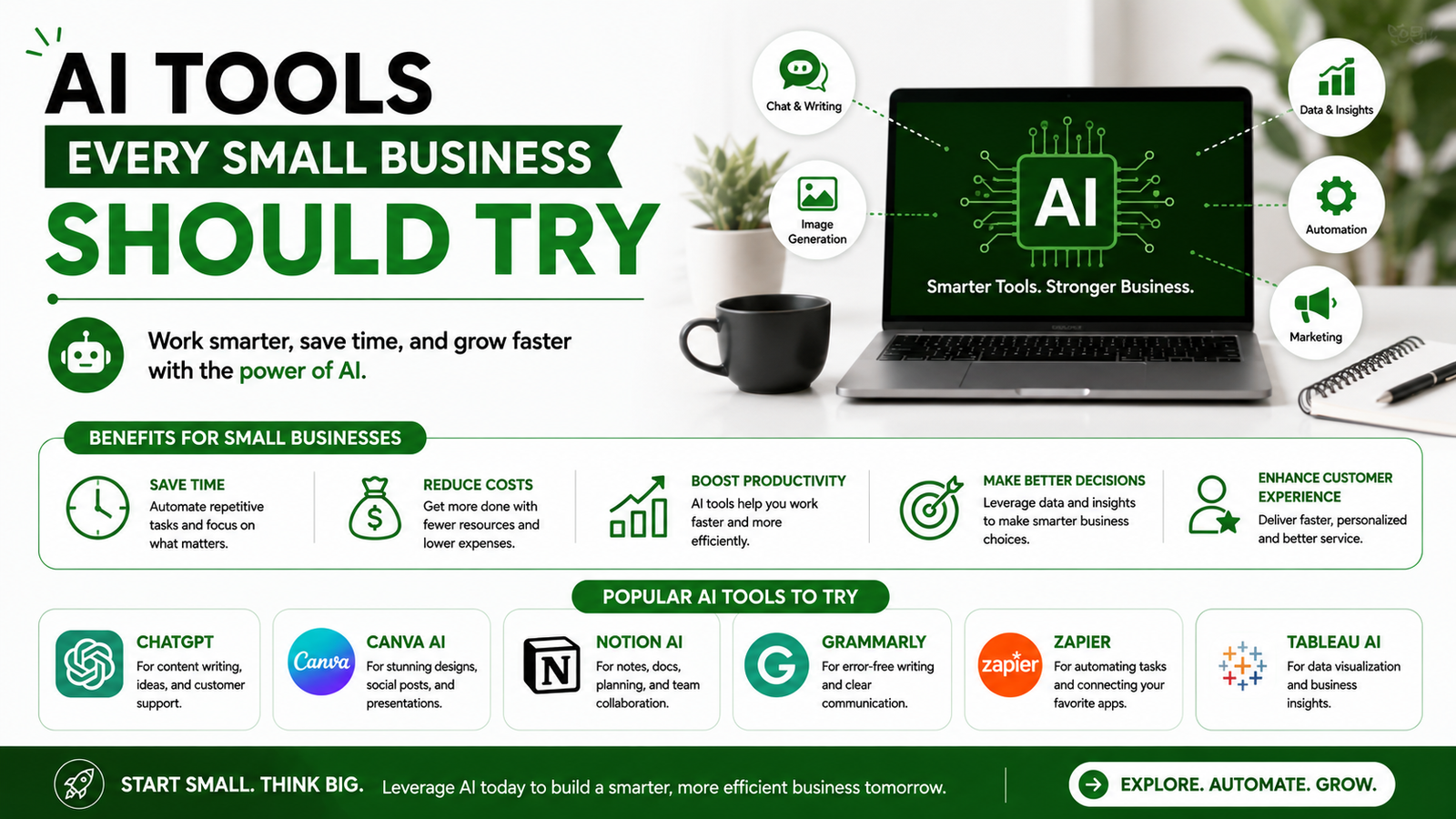
Artificial intelligence is helping small businesses automate routine work, improve customer experiences, and operate more efficiently than ever before. In the past, AI was mostly used by large companies with big budgets. Today, it is available to businesses of all sizes. Many small businesses are using AI to save time, improve customer service, create content, and automate everyday tasks.
There are many AI tools for small business owners that can make running a company easier. Whether it is helping with marketing, customer support, or organization, AI can help business owners focus more on growing their business instead of spending hours on repetitive work.
Best AI Tools for Small Business
One of the most popular business automation tools is ChatGPT. It can help write social media posts, emails, blog articles, and product descriptions in just a few minutes. Instead of staring at a blank screen trying to come up with ideas, business owners can use AI to create a starting point and save valuable time.
Another useful tool is Canva AI. Many small businesses do not have the budget to hire a graphic designer, so Canva AI helps create professional-looking social media posts, flyers, and advertisements. It is simple to use and can make a business look more professional online.
For customer service, tools like Zendesk AI and Tidio can answer common customer questions automatically. If a customer wants to know store hours, shipping information, or return policies, AI chatbots can respond instantly, even outside of business hours.
Businesses that conduct frequent meetings can also benefit from tools like Otter.ai and Fireflies.ai. These AI-powered meeting assistants automatically record conversations, generate transcripts, summarize key discussion points, and create action items. This helps teams stay organized and reduces the need for manual note-taking.
When it comes to organization and productivity, Notion AI is one of the best AI productivity tools for business. It helps keep track of projects, create notes, and organize important information. Microsoft Copilot is another helpful option because it works with Word, Excel, and Outlook to make everyday tasks faster.
For research and information gathering, Perplexity AI has become a popular choice. It helps business owners quickly find answers, summarize complex topics, and gather insights from multiple sources, making research faster and more efficient.
Businesses looking to automate tasks should consider Zapier. It is one of the most popular small business automation tools because it connects different apps and automates workflows. For example, when a customer places an online order, Zapier can automatically send a confirmation email and update customer records without anyone having to do it manually.
Email marketing is another area where AI can save time. Platforms like Mailchimp AI and Brevo AI help businesses create email campaigns, generate content suggestions, segment audiences, and optimize send times. These features help improve engagement while reducing the amount of manual work required.
HubSpot AI is another useful option for businesses looking to improve marketing, customer relationship management, and lead nurturing efforts.
Finally, QuickBooks AI is a great example of AI software for small businesses. It helps track expenses, organize financial records, and monitor cash flow, making it easier for owners to understand how their business is performing.
How a Small Business Can Use AI
Imagine a small clothing store called Urban Threads. The owner does not have a large staff and handles most of the business alone.
Using ChatGPT, the owner creates social media posts promoting a summer sale. Canva AI designs graphics for Instagram and Facebook. Zapier automates order confirmations and customer emails. Zendesk AI answers customer questions on the website, while QuickBooks AI keeps track of sales and expenses.
Instead of spending hours completing these tasks manually, the owner can focus on customers and growing the business. This is why many entrepreneurs consider these tools some of the best AI tools for business available today.
Benefits and Limitations of AI
The biggest benefit of AI is that it saves time. Small business owners can automate repetitive tasks, create content faster, and improve customer service without hiring additional employees. AI can also help reduce costs and increase productivity.
However, AI does have limitations. It is not always accurate, and businesses should review AI-generated content before publishing it. AI also cannot replace human creativity, personal relationships, or important business decisions. It works best as a tool that supports people rather than replaces them.
Conclusion
AI is changing the way businesses operate, and it is becoming an important resource for entrepreneurs. There are many AI tools for small business owners that can help with marketing, customer service, organization, and automation. The best AI tools for business allow companies to work more efficiently, save money, and focus on growth.
While AI is not perfect, it can be a valuable tool when used correctly. As technology continues to improve, more businesses will likely adopt AI software for small businesses to stay competitive and meet customer expectations.
FAQs
Which AI tool is best for small business?
The answer depends on the business. ChatGPT is great for content creation, Canva AI helps with design, Zapier is useful for automation, QuickBooks AI assists with financial management, and HubSpot AI supports marketing and CRM activities. Many businesses use a combination of tools rather than relying on just one.
What can small businesses use AI for?
Small businesses can use AI for marketing, social media content, customer service, bookkeeping, scheduling, workflow automation, and data analysis. AI helps save time and improve efficiency.
What is the 30% rule for AI?
The 30% rule is the idea that AI should assist with part of a task while humans handle the rest. AI can help generate ideas, create drafts, or automate simple work, but people should still review and make final decisions.