
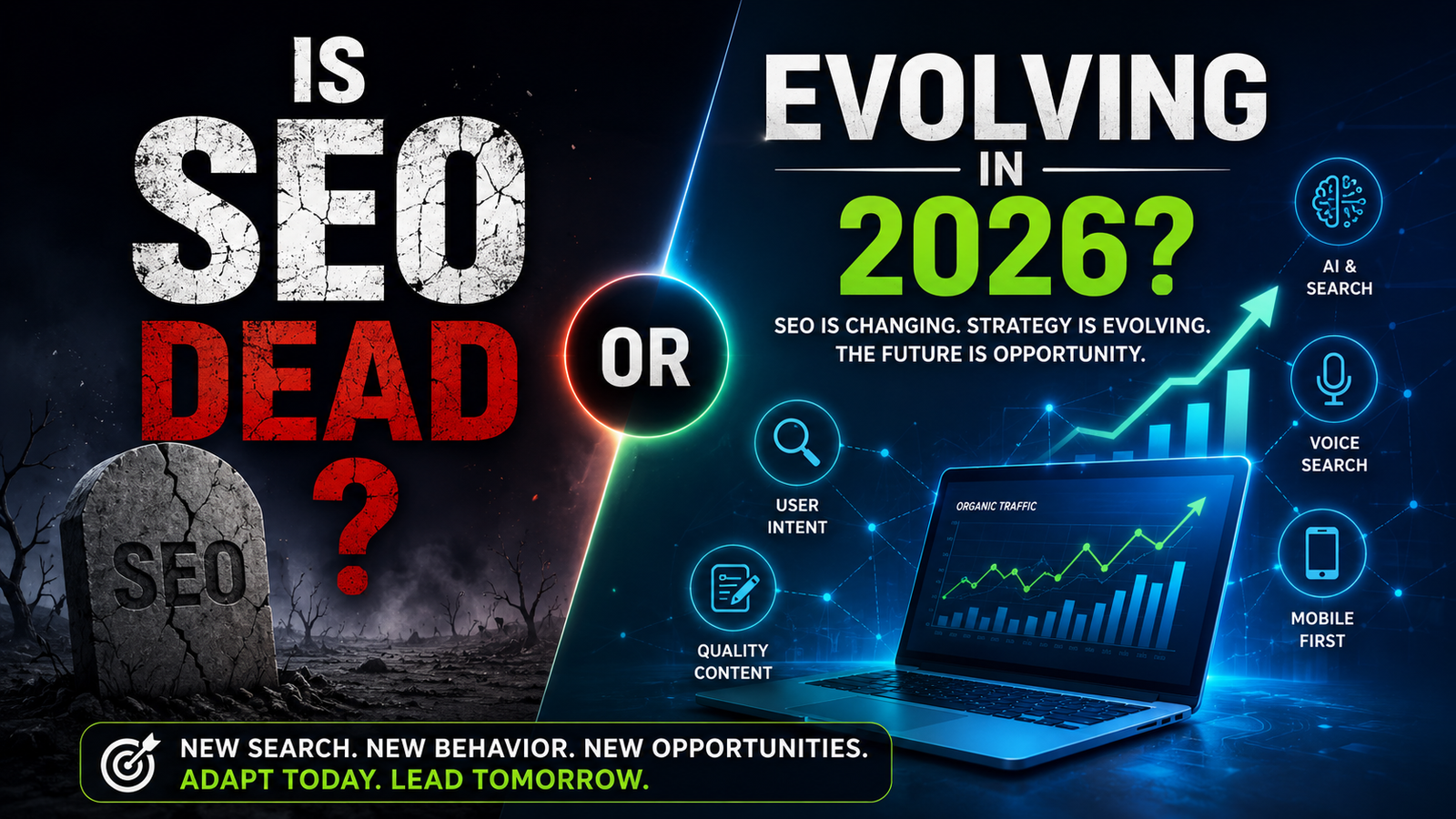
Search engine optimization (SEO) refuses to die, but it barely resembles the SEO we knew five years ago. Ask any marketer who watched their organic traffic dip while their brand mentions in ChatGPT answers climbed. These are the people who will tell you something shifted.
So, the real question isn’t whether SEO in 2026 survives. The real question is whether your strategy has caught up with where search actually happens now.
Truth Behind the SEO Death Debate
Plenty of headlines claim SEO is dead, and honestly, the panic makes sense on the surface. AI Overviews now answer a huge share of Google queries before users ever click a link.
Meanwhile, people are asking Perplexity, Gemini, and ChatGPT questions they once typed into a search bar. Naturally, click-through rates for traditional organic listings have dropped in queries where AI summaries appear.
However, the data tells a more nuanced story. AI models still pull their answers from indexed, crawlable web content.
Therefore, strong technical SEO still determines whether your site even gets considered as a source. Consequently, generative engine optimization builds directly on top of traditional SEO rather than replacing it.
Google itself still processes trillions of searches a year, and most of those searches never trigger an AI Overview at all. So, SEO isn’t dying. It’s splitting into a wider discipline that covers search engines, answer engines, and AI chat platforms all at once.
How AI Search Optimization Is Reshaping Rankings
AI systems don’t rank pages the way Google’s algorithm does. Instead, they take information from multiple sources and generate a single answer. It means visibility now depends on being cited, not just being clicked.
An effective AI search optimization approach focuses on clarity, structure, and extractability. All AI models favor content that they can quote and summarize without confusion.
Today, trust signals matter more than ever. LLM systems weigh authorship, expertise, and source credibility before deciding what to cite in a response. This aligns with Google’s E-E-A-T principles.
Regardless of all the changes, backlinks still carry weight. AI tools rely on live web search and public datasets to find and trust signals.
For that reason, businesses now invest heavily in LLM optimization. It means writing content that large language models can understand, verify, and reuse safely. Structured headings, direct answers, and factual accuracy all play a role here.
Building a Smarter SEO Content Strategy for 2026
The new SEO content strategy treats every page as an answer to a real question. It is no longer just a keyword target.
To start, content needs semantic depth. It means content should cover related subtopics a reader or an AI model would naturally ask about.
Second, every page should include direct, well-organized answers near the top, since AI systems often extract specific sections rather than entire articles.
Furthermore, AI SEO strategy planning now includes tracking visibility across ChatGPT, Perplexity, and Gemini, not just Google Search Console.
Nowadays, businesses are testing their own brand queries across platforms. They are testing to see how they get mentioned and how accurately they are described. Once you know what and where you are missing, you can adjust your content and close that gap.
Eventually, SEO in 2026 rewards brands that publish original insight, cite real data, and avoid generic filler that adds nothing new to a topic.
Why Local SEO Optimization Still Has Importance
Local businesses might assume AI search only benefits huge national brands. However, that assumption misses the bigger picture.
Even to this day, local SEO optimization remains essential. People today ask Google about plumbers near me, plumbers open right now, or which dentist takes their insurance.
Google Business Profiles, accurate citations, and location-specific content still influence whether a local business shows up in these answers.
Similarly, reviews and reputation signals carry extra weight in AI-generated local recommendations. So, updating your business information consistently across directories isn’t a small task anymore.
It’s part of how AI models judge whether your business is real, active, and trustworthy enough to recommend.
What This Means for Your Business
Businesses that treat SEO as a static checklist will fall behind. On the other hand, businesses that treat it as an evolving visibility strategy will keep showing up wherever their customer searches.
Your content needs to work across Google, AI Overviews, and chat-based assistants at the same time. That’s a bigger job than SEO used to be, but it’s also a bigger opportunity for brands willing to adapt early.
Frequently Asked Questions
Will SEO be replaced by AI?
Not likely anytime soon. AI search tools still depend on crawlable, well-structured web content to generate their answers, so SEO fundamentals remain the foundation everything else builds on. What’s changing is the goal. You’re no longer optimizing purely for rankings. You’re optimizing to get cited and mentioned by AI systems too.
What is the trend in SEO in 2026?
The biggest trend right now is the merging of traditional SEO with generative engine optimization and answer engine optimization. Brands are now tracking visibility across AI platforms. The results are not limited to the search engine result pages. Content structure, factual accuracy, and topical depth matter more than keyword density ever did.
How does SEO work in 2026?
It works on two levels now. Traditional ranking factors like site speed, backlinks, and relevance still apply. Similarly, content needs to be extractable and trustworthy enough for AI models to summarize and cite accurately when generating direct answers to user questions.
Will SEO exist in 5 years?
Yes, though it will likely look even more integrated with AI systems than it does today. As long as people search for information online, there will be a discipline focused on helping businesses get found, whether that happens through a search engine, a chat assistant, or whatever comes next.
Final Thoughts
SEO hasn’t died. It has grown into something broader, messier, and honestly more interesting than it used to be. Businesses that keep publishing thin, keyword-stuffed content will struggle either way.
But businesses that focus on genuine expertise, clear structure, and real answers will keep earning visibility, no matter which platform their customers use to search.
If you want help building a content strategy that works across both traditional search and AI platforms, the team at 14K BSol can help you get there.