
Most websites do not lose rankings because Google changed everything overnight, they lose it because they abandoned tactics that never stopped working.
Meanwhile, marketers chase every algorithm rumor while ignoring the on-page fundamentals sitting right in front of them.
So, this guide breaks down exactly which tactics still deliver results in 2026. Moreover, how to apply them without wasting time on trends that never mattered much to begin with.
On Page SEO Techniques Google Still Rewards
Search engines process content far more intelligently than they did a few years ago. Yet certain on page SEO techniques remain just as important now as they were back then.
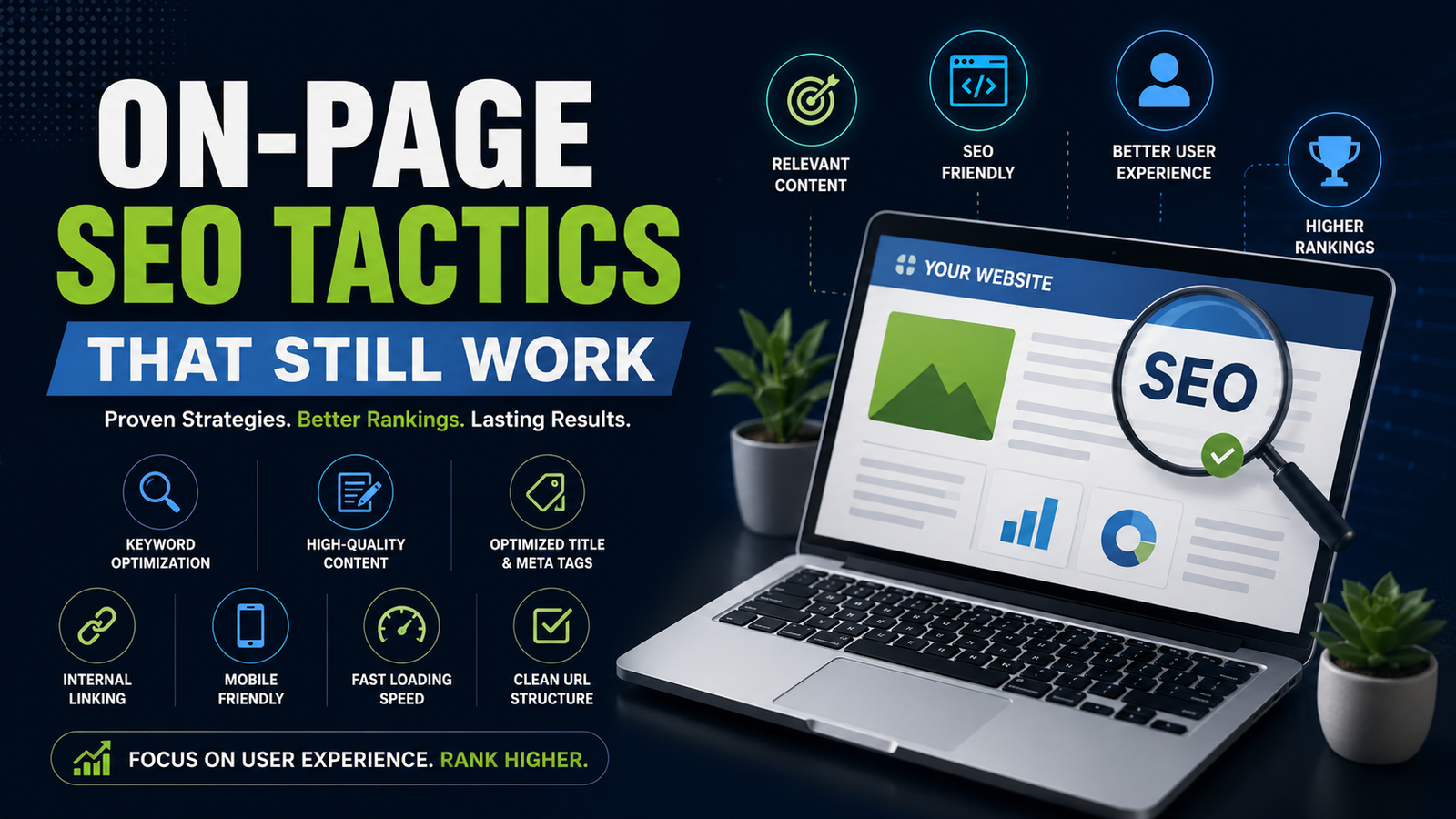
Firstly, the title tags placed near sixty characters and meta descriptions written with a clear call to action weigh a lot for SEO. Also, header tags organized in a logical hierarchy still shape how well a page performs.
Beyond that, page speed and mobile responsiveness carry real weight in ranking decisions. Interaction to Next Paint replaced older speed metrics. Similarly, pages that load sluggishly on mobile devices routinely lose ground to faster competitors.
Consequently, technical health and content quality now function as two halves of the same ranking equation rather than separate priorities.
Crafting a SEO Content Strategy That Actually Converts
Evidently, good content starts with understanding what a searcher truly needs. The results do not depend anymore on what words they typed into the search bar.
A solid SEO content strategy groups related keywords around a single, well-developed page instead of scattering thin content across dozens of near duplicate posts.
This approach signals topical depth, which search engines and AI systems both reward.
Additionally, placement matters just as much as frequency. Your primary keyword should appear naturally within the opening paragraph, and supporting terms should surface throughout the body without feeling forced.
Every section should answer the question its heading implies right away, since readers skim before they commit to reading in full.
From there, seo content optimization becomes an ongoing process of refreshing pages that lose traffic rather than a onetime task you finish and forget.
Learning to Optimize Content for Google AI Overview Placements
AI generated summaries now appear across a growing share of search results. Ignoring them means giving up visibility and you can’t easily win back elsewhere.
Therefore, learning to optimize content for google AI overview results has quietly become part of standard on page work.
Content written in clear, self-contained sections tends to get pulled into these summaries more often than content that buries answers deep in long paragraphs.
Schema markup plays a supporting role here too. FAQ schema and article schema give search engines structured signals about what a page covers, which makes it easier for AI systems to extract accurate information.
Since these systems favor evidence-backed, factual writing, vague claims without support rarely earn a citation.
Why Internal Linking Strategy Deserves More Attention
Internal links often get overlooked, yet few tactics deliver returns this reliably. A well-planned internal linking strategy connects related pages, spreads ranking authority across your site, and helps both visitors and search crawlers understand how your content fits together.
Sites that link generously between relevant pages consistently outperform those that treat every post as an island.
A practical on page SEO checklist should include three to five internal links per thousand words. Each using descriptive anchor text rather than generic phrases like click here. Image optimization deserves a place on that checklist too.
Many websites still skip descriptive alt text entirely, even though image search accounts for a meaningful share of overall search volume. Compressing file sizes and writing complete, descriptive alt text improves both accessibility and visibility.
Local SEO Optimization for Location-Based Businesses
Businesses that serve a specific city or neighborhood have to face a different set of challenges compared to brands that deal nationwide.
In such scenarios, local SEO optimization remains essential here. AI assistants and traditional search results both rely on accurate, consistent business information to make local recommendations.
Inconsistent addresses or outdated phone numbers across directories quietly damage visibility over time.
Furthermore, content built around real local questions performs noticeably better than generic service pages.
Customer reviews, service area pages, and neighborhood specific details all help search engines and AI systems understand exactly who a business serves and where.
Businesses that keep this information current tend to show up far more often when nearby customers go looking.
Final Thoughts
Lastly, on-page SEO hasn’t lost its value, and the businesses treating it as outdated are the ones falling behind fastest.
Instead, the discipline has grown more demanding, rewarding sites that combine technical precision with genuinely useful, well-organized content.
Hence, the companies that master these fundamentals while adapting to how AI systems read and cite information will keep earning visibility no matter how search continues to evolve.
If your business needs a content strategy built for how people actually search in 2026, the team at 14K BSol can help you put one together.
Frequently Asked Questions
What is the 80 20 rule of SEO?
The 80 20 rule is a great rule of SEO. It divides the segment, a small portion of your pages, which make up to 20 percent, generate the majority of your organic results. Identifying which pages already perform well and doubling down on optimizing them tends to produce far better returns than spreading effort evenly across your entire site.
What are the 3 C’s of SEO?
The 3 C’s mean content, code, and credibility. Content covers if your pages genuinely satisfy what the searchers need. Code refers to the technical foundation that allows search engines to crawl and interpret your site correctly. Credibility involves the trust signals and authority that convince both search engines and AI tools to recommend your business.
What are the top 5 SEO strategies?
The strategies that consistently deliver results include keyword research. It is also built around real intent and on-page optimization covering titles and headers. Meanwhile, technical performance improvements like faster load times, quality backlink building, and regular content updates. These five areas form the backbone of visibility for traditional search and AI powered platforms.